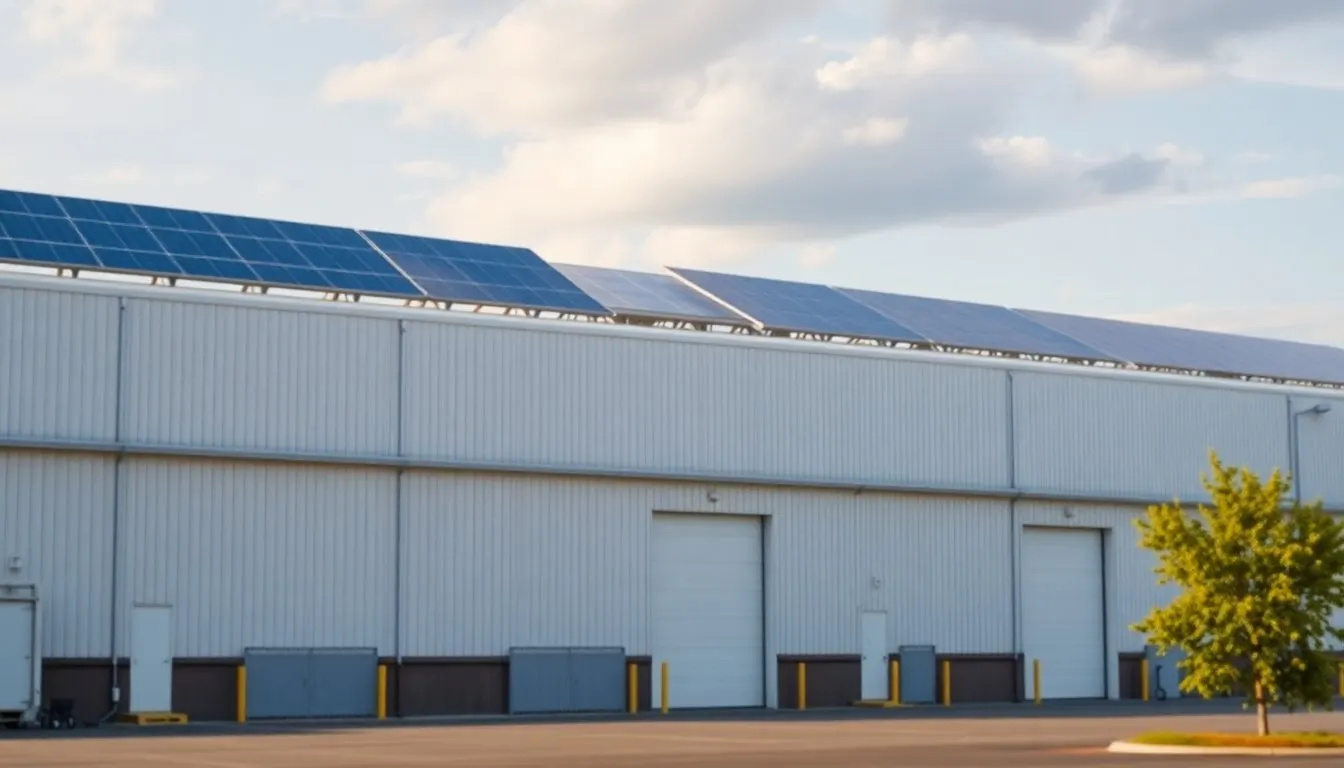
Cold stores are a good fit for rooftop solar because the compressors never stop. Most of the power a roof array makes at midday gets used in the building, not sold at a lower export rate. That is what drives payback. The catch is that solar still covers only a slice of a cold store’s total demand, because the plant also runs all night. So size the array against the site’s real load, check the roof panels carefully, and be honest about what the system will and will not deliver.
A general warehouse looks different. Its load peaks while staff are in and falls away in the evening. A cold store’s load stays high at 3am, at weekends and on bank holidays. Our guide to solar for warehouses and logistics covers the ordinary shed. This one covers what changes when the building is a fridge.
What the evidence says about self-consumption
Published data on this is thin, so here is one peer-reviewed study. Researchers at the University of Jaén looked at two industrial cooling and refrigeration sites in Spain with PV on site. They found self-consumption of about 90%, meaning almost all the solar output was used on site. They also found that solar covered only about 25% of each site’s total demand over 24 hours, and roughly half of it during sunshine hours.
Two points follow. Self-consumption is high, which is good for the money case. But solar will not make a refrigerated site self-sufficient, so the claim you can make about your electricity bill or carbon figure needs care. Those sites are in Spain, so UK results will differ with weather and load. Use your own half-hourly meter data to test it.
Size against the baseload, not the roof
The usual question is “how much roof do we have?”. For a cold store the better question is “what is our lowest steady demand, day and night?”. Pull a full year of half-hourly data from your supplier or smart meter. Look at the lowest weekday and weekend daytime demand, and at the summer shoulder months.
An array that never exceeds that floor will use almost everything it makes. A larger array exports on quiet days, at the Smart Export Guarantee rate. Our guide to the Smart Export Guarantee explains why export value is usually lower than the price of power you avoid buying. Model a few sizes and compare the return on each extra block of panels.
Know your plant’s real energy use first
Refrigeration is usually the biggest single use of power in a cold store. Dr Andy Pearson of Star Refrigeration published modern benchmarks through the Cold Chain Federation in March 2020. He measures refrigeration plant in kilowatt-hours per cubic metre of store per year. The older UK “best practice” figure for low-temperature stores of about 100,000 m³ was over 30. He puts a modern, well-maintained store of that size at about 10, and a very large 500,000 m³ store below 5. Star Refrigeration’s write-up adds that glycol systems and other designs run higher.
Why does this matter for solar? If your plant is inefficient, efficiency work may beat panels on payback, and it also changes how big an array you need. Ask for a refrigeration energy review before you size anything. Fixing the plant and adding solar can be done together.
System size and cost
Because cold stores are often large buildings, a roof array in the hundreds of kilowatts is common, and larger groups reach a megawatt. Instead of quoting a price here, we point you to our cost and payback pages, which set out bands by system size, such as our 500kW page. Your own quotes should replace any guide figure.
On tax, HMRC’s manual says that all capital expenditure on solar panels is designated special rate, so it does not qualify for full expensing. The Annual Investment Allowance of £1 million a year may apply, but cold-store operators often spend heavily on plant in the same year, which can use up the allowance. Model the real after-tax figure with your accountant. Our piece on the full expensing mistake explains the trap.
Insulated roofs need their own checks
Many cold stores have roofs made of insulated sandwich panels, with steel skins around a foam core. They are designed to hold a temperature, not to carry point loads. Two things follow.
First, how the array is fixed. Sandwich-panel makers often restrict what can be attached to the outer skin. Get the panel manufacturer’s written approval of the mounting method, and check what it does to the roof warranty. In many designs the load is carried by the structure below rather than the panels.
Second, the vapour barrier. In cold stores it sits on the outside of the insulation, which is the reverse of normal buildings, so a hole through it can let moist air in. Any fixing or cable route through the roof needs a designed seal, with the cold store’s designer involved. Ballasted systems avoid holes, but add weight.
These are general points, so your roof may still differ. The structural and roof assessment should cover them in addition to the usual purlin and corrosion checks. Our guide to roof surveys before solar lists what a good report contains.
Does a battery make sense?
Sometimes, and the reason is usually resilience rather than energy trading. If a power cut puts a full store of frozen stock at risk, backup power has a value of its own. A solar array alone will not run the plant in an outage unless the system is designed for island mode. A battery sized to the critical load is a different design from one sized to save energy cost.
Our guide to whether commercial solar batteries are worth it sets out the energy-cost case. For a cold store, treat resilience as a separate question, and cost the alternatives, such as a generator, in the same comparison.
Grid connection
Commercial-scale arrays connect under the engineering standard G99. A cold store may already draw close to its supply capacity around the clock, so ask the network operator about headroom for both import and export early. Our G99 guide covers the steps, and our note on UK grid capacity in 2026 covers the wider picture.
Where studies usually go wrong
Operators rarely lack a business case. The usual errors are sizing the array to summer generation rather than the site’s flat load, and skipping the insulated-roof detail that a standard warehouse survey ignores. A feasibility study covers both: a year of half-hourly data, a structural and roof assessment for insulated panels, and a network enquiry, run together. Our work for industrial and manufacturing sites follows the same path.
Because a cold store runs all week, sizing matters more than roof area. A feasibility study checks the roof panels and the grid. Energy and ROI modelling tests array and battery sizes against your load, while PPA and financing advice compares funded options. For a group of stores, portfolio optimisation sets the order. For another round-the-clock load, see solar on poultry farms.