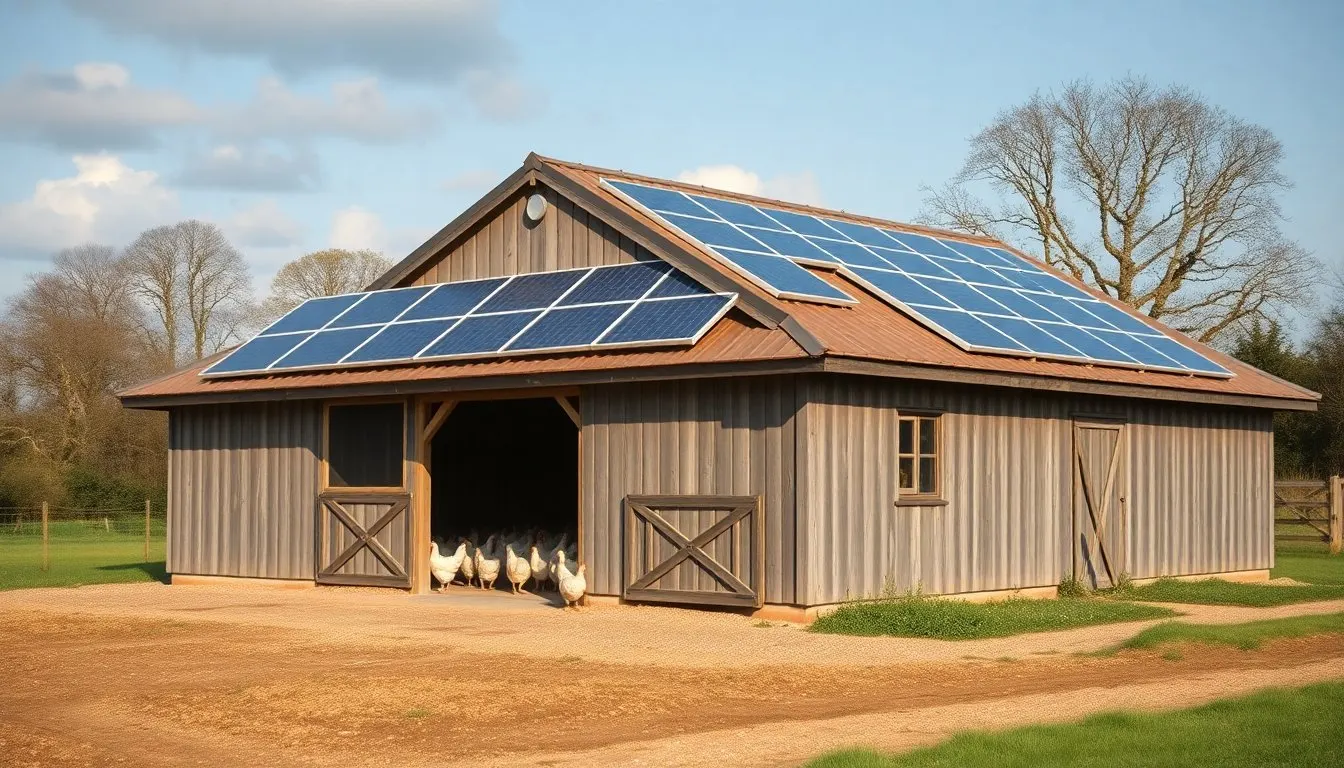
A poultry house needs power day and night, and solar only makes it by day. That mismatch is the key to the sums. A rooftop array on a poultry shed usually finds a use for most of its daytime output, but it cannot cover the night. How much a battery adds depends on your own meter data, and you should look at that before you size anything.
Why the load is unusual
Many farm buildings have a daytime pattern. A dairy has peaks around milking. A grain store runs mainly at harvest. A poultry house is different because the birds live in it and the air has to keep moving.
Two legal points shape the load. Ventilation must work whenever birds are inside, and lighting must follow a set pattern.
- Ventilation. The Welfare of Farmed Animals regulations require that where animal health depends on artificial ventilation, there must be a back-up system that guarantees enough air renewal, and an alarm that works even if mains power fails. Paragraphs 20 and 21 also require the back-up to be inspected and the alarm tested at least every seven days.
- Lighting for broilers. Defra’s guidance says meat chickens must have a 24-hour light rhythm with at least 6 hours of darkness in total, including one uninterrupted period of at least 4 hours.
- Lighting for laying hens. The code for layers says lighting must follow a 24-hour rhythm with an uninterrupted dark period of about one third of the day.
So lights are on for part of the day and ventilation is on all of it. The fans’ output varies with bird numbers, age and the weather, but the base load never falls to zero while birds are housed. Between flocks, when sheds are cleaned and empty, demand can drop sharply. Your meter data will show both patterns.
What the meter does not show
Heating is a separate matter. In many poultry houses brooders run on gas, oil or biomass, not electricity, so the heating bill may not be on your electricity meter at all. Solar offsets the electricity you buy. Check which fuels your sheds use before you credit solar with heating savings.
What a flat load means for solar
A steady load helps a rooftop array in one way and limits it in another.
It helps. When the sun is up the load is already running, so more of the array’s output is used in the building. The less you export, the less you depend on a low export rate under the Smart Export Guarantee.
It limits. Solar generates only in daylight, so it cannot cover the night load on its own.
An illustrative check
Take a made-up farm with sheds that average 20 kW of demand across all 24 hours. That is 175,200 kWh a year. Assume a 100 kWp array on the roofs, giving 90,000 kWh a year at 900 kWh per kWp. Even if every unit of solar was used on site, the array would meet about 51% of annual demand. In practice summer midday output exceeds a 20 kW load, so some power would be exported, and the real share used on site would be lower. The figures are assumptions, not data from a real holding.
The lesson is general: a flat load puts a ceiling on how much of your demand solar can meet, and it sets how much an extra battery could shift from day to night.
Is a battery worth it?
Adding storage moves midday surplus into the evening and night. A site with a high night base load has more to gain than a site with none. The decision still turns on cost, cycling and the difference between what you pay for grid power and what you earn from export. Our article on whether commercial battery storage is worth it sets out the checks. A poultry farm is more likely than most to pass them, but only your half-hourly data will tell you.
Could solar help with the backup duty?
Possibly, but handle it with care. The regulations ask for a back-up system that guarantees enough air renewal. They do not say solar or a battery will do. A standard grid-tied solar system shuts down when the grid fails, as a safety feature, so panels alone give you no backup. A battery designed to run chosen loads in a power cut could form part of the answer. That design needs to be specified on purpose and agreed with whoever is responsible for your welfare compliance. Do not assume a normal solar-plus-battery package does it.
Roof and grid points
Poultry sheds often have large, clear roof spans, but check these before you commit.
- Asbestos. Older sheds can have asbestos cement sheeting. Under the Control of Asbestos Regulations 2012, the person responsible for maintaining non-domestic premises must manage it. Such roofs are fragile and may need replacing before panels go on. See roof surveys, structural loading and asbestos.
- Structure. Ask an engineer to confirm the roof can take the load.
- Grid. A rural feeder may have limited room. Read our guide to rural grid connections and G99 delays, and the G99 explainer for the process.
Our agriculture and land sector page covers the wider picture for farms, and the post on dairy farm solar shows how a different load shape changes the answer.
Getting the numbers right
The most useful step is a feasibility study built on your half-hourly meter data. It shows how much of the array you would use, what a battery adds and whether the grid will take the rest, before you spend on equipment.
Because the load runs day and night, the numbers need care. Our energy and ROI modelling tests array and battery sizes against your meter data. PPA and financing advice covers funded options, while procurement and tender support makes sure installers quote for the backup design you need. On a farm with several units, portfolio optimisation shows which shed to start with.