Should your organisation go solar? Get an answer with no sales pitch.
Solar Strategies helps UK organisations decide whether solar is worth it, and then buy it well. Because we don't sell panels or take a cut from installers, our only product is a straight answer.
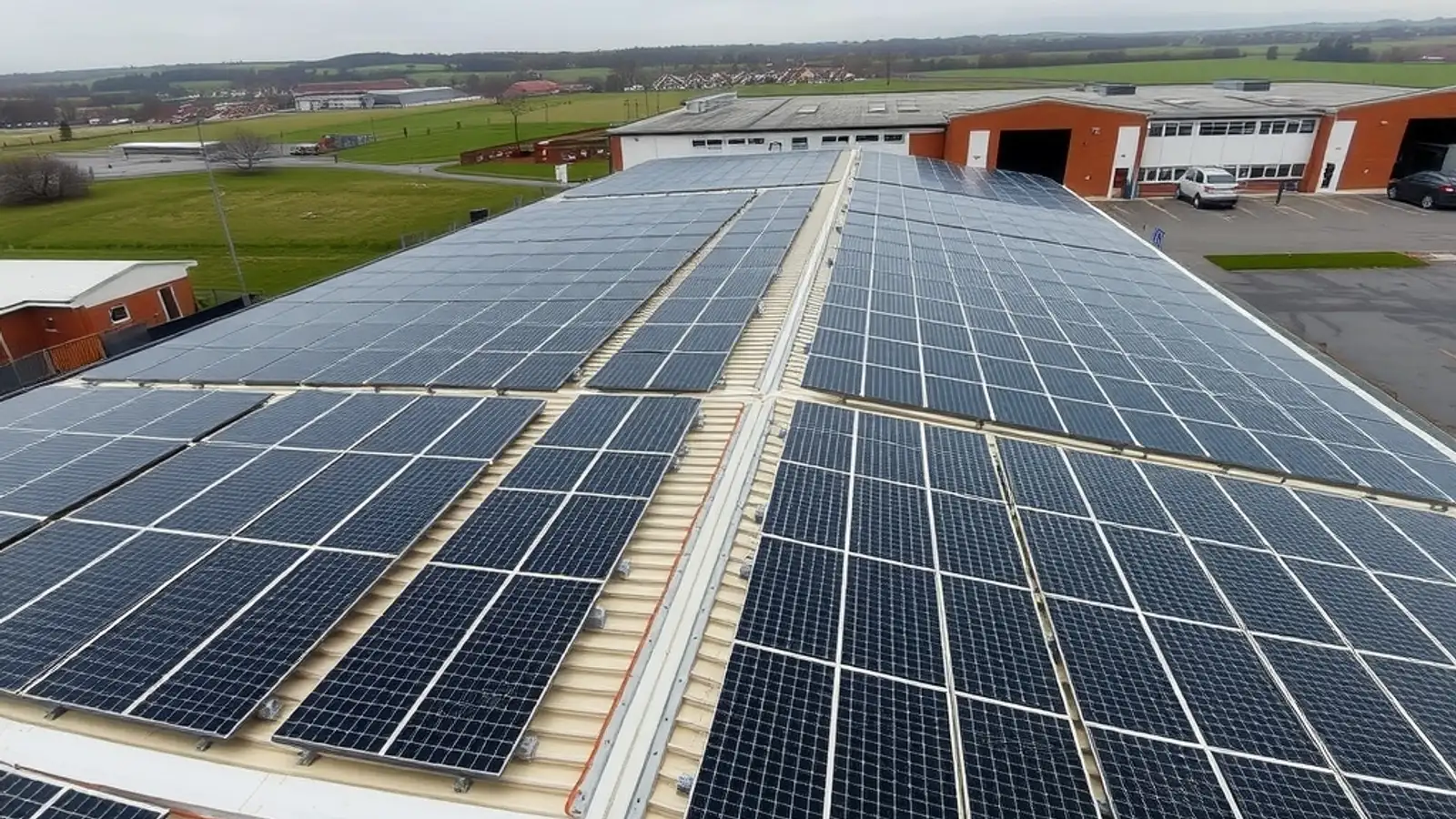
What this site is, in plain terms
Solar Strategies is a commercial solar advice service. It is for firms, landlords, farms, developers and public bodies in Great Britain. You tell us about a site, for example a warehouse roof or a spare field. We tell you, with our working shown, whether panels there would pay their way.
If the answer is yes, we can help with the next steps too. That means a fair tender, a check on any funding deal, and a watch on the work as it goes in. If the answer is no, you hear it early, while it is still cheap to change course.
We earn nothing from the kit you choose. No installer pays us a fee for sending you their way. That is the whole point of the service, because advice is only as good as the motive behind it.
Five things that decide whether commercial solar pays
Most bad solar deals fail on one of these five points. None of them shows up on a glossy quote. Yet each one is a fact you can check, and we link to the rule-maker's own page so you can.
1. How much of the power you will use yourself
A unit of solar power you use on site saves you the full price you pay your supplier. A unit you send to the grid earns far less. Under Ofgem's Smart Export Guarantee, your supplier sets that export rate. The only rule is that it must be above zero, and the scheme covers sites up to 5MW. So the shape of your daytime demand matters more than the size of your roof, since unused power is sold cheaply.
Source: Ofgem, Smart Export Guarantee. More: our guide to how SEG export payments work.
2. Whether the local grid can take it
Small systems connect through a simple notice to the network operator. Larger ones need a G99 application, and the operator must agree before you connect. In busy parts of the network, that can mean upgrade costs or a long wait. A quote that ignores the grid is not a real quote, however good the price looks.
Source: Energy Networks Association, G98 and G99 forms. More: G99 in plain English.
3. How tax treats the spend
HMRC lists solar panels as "special rate" spend, and has done since April 2012. That rules out 100% full expensing, which is a common sales-deck mistake. The Annual Investment Allowance of £1 million a year can still cover the cost, but it is shared with all your other plant spend. Above that, only companies can use the 50% first-year allowance, and the kit must be new and unused.
Sources: HMRC manual CA22335,GOV.UK, Annual Investment Allowance,GOV.UK, full expensing. More: the full expensing trap, explained.
4. Whether the roof can carry it
Panels and frames add weight that stays for 25 years or more. Old steel sheds, fragile roof sheets and asbestos cement all change the plan. If the roof will need replacing within the life of the system, it is often cheaper to do both jobs at once, because lifting the panels off later costs money.
Source: HSE, where asbestos may be found. More: what a roof survey should check.
5. How you pay for it
You can buy the system, lease it, or let a funder own it and sell you the power under a PPA. Buying gives the biggest saving if you have the cash. A PPA needs no capital, although you give up part of the saving and sign up for many years. The right choice turns on your cost of capital and how long you will stay on the site.
More: buy, lease or PPA comparedand what commercial solar costs in 2026.
What working with us looks like
It starts with a short, free call about your site and your goal. Lower bills, fixed costs, a carbon target and a tenant's demands all lead to different answers, so the goal comes first. After that call, we tell you what we would need to look at and what it would cost to do so.
You can hire us for one piece of work or the whole job. A common first step is afeasibility study. Others ask us to run a tenderor to review a PPAbefore they sign. Each step has a clear scope and a fixed output.
Every number we give you comes from your own data or a stated, sourced assumption. If a figure is a guess, for instance a future power price, we label it as one. Your board, your auditor or your lender should be able to follow every line.
Find the guide for your situation
- Running a factory, warehouse or office? Start with ourguide for industrial sites or theone for offices and retail.
- Own a farm or open land? Weigh upleasing land against using the power yourself, then read the farm and land guide.
- A school, council or other public body? Seeour public sector notes andbuying solar under the Procurement Act 2023.
- Building something new? Read ournotes for developers.
- Want a rough price first? Ourcost guides by system sizerun from 100kW to 1MW and up.
- Checking the rules where you are? Planning and grid queues vary, so seeScotland,Wales or theEnglish regions.
What you will not find here
You will not find made-up savings, star ratings or a wall of client logos. We would rather show our method, because you cannot check a claim. Ourworked examplesare exactly that: sample sites with the assumptions written out, not real clients.
We also keep our guides tied to the rules. Tax, grid and export facts link to HMRC, Ofgem, the ENA or GOV.UK. When a rule changes, the guide should change with it, since an old rule can cost you money. If you spot one that is out of date, tell us.
Ask about your site
Tell us what the building or land is and what you want from it. A person reads every message and replies by email, usually within one working day.
The first call is free. If solar does not look worth it for you, we will say so on that call.
Common first questions
Does Solar Strategies sell or fit solar panels?
No. We give advice and nothing else. There is no kit to sell and no install team to keep busy. That means we can tell you a project is not worth doing, and we will if the numbers say so, even while you are keen.
What does an independent solar adviser do that an installer does not?
An installer's survey is the first step towards selling you a system. Our job ends with a decision you can defend. We test the site, build the business case on your own bills, write the spec and help you buy well.
Who is this advice for?
UK firms, landlords, developers, farms and public bodies thinking about solar on a roof, a car park or a field. One site or many, the questions are the same: will it pay, can the grid take it, and how do we buy it?
Can you look at a quote or a PPA we already have?
Yes. Many people come to us with a quote, a lease offer or a power purchase agreement on the table. We check the size, the yield, the price and the contract terms before you sign.
Where do you work?
Across England, Scotland and Wales. Most of the early work is done from your data, so where you are rarely matters. Still, planning and grid rules differ by nation. We account for that in every answer.
Got a site in mind?
Send a few lines about the building or land and what you hope to get from it. We'll reply with an honest first view and what we'd need to check next.