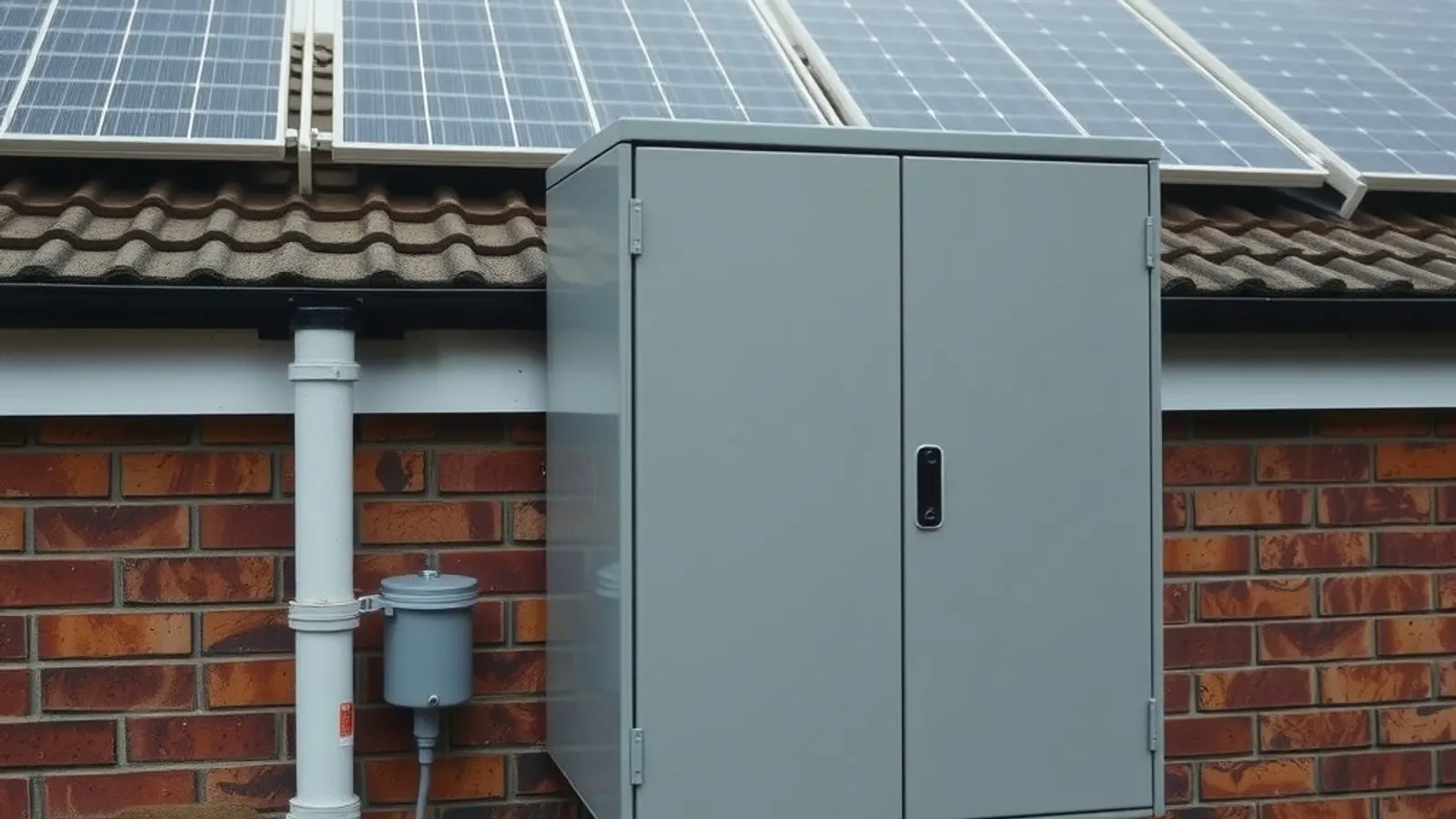
The Smart Export Guarantee (SEG) is the rule that makes electricity suppliers pay you for power you send to the grid. It covers solar PV, onshore wind, hydro and anaerobic digestion up to 5MW, and micro-CHP up to 50kW. Suppliers set their own rates, so what you earn depends on which supplier you choose. For most businesses it is the smaller part of the solar business case. Power you use yourself is usually worth more.
What the scheme is
SEG started on 1 January 2020. Ofgem’s guidance for generators says it is built on the SEG Order and licence conditions. Licensed suppliers must offer at least one export tariff to any generator with an eligible installation.
Suppliers decide the rate, the type of tariff and its length. However, there is one limit. The tariff must be greater than zero pence per kilowatt hour exported at all times. There is no set minimum rate and no maximum.
Payment is for exported units only. You are paid for the kilowatt hours you send out, measured at the export meter. There is no payment for what you generate and use on site.
Which suppliers must offer a tariff?
Under the same guidance, licensed suppliers with at least 150,000 domestic electricity customers must offer one. Smaller suppliers can join if they choose. Ofgem keeps a list of SEG licensees. For the SEG year from 1 April 2026 to 31 March 2027 it shows 12 mandatory licensees and 4 voluntary ones. The names change from year to year, so check the page when you are ready to apply, not an article.
You do not have to export to the supplier you buy from, since you can import from one firm and export to another.
What size and type of system qualifies?
| Technology | Limit |
|---|---|
| Solar PV, onshore wind | Total installed capacity up to 5MW |
| Hydro, anaerobic digestion | Total installed capacity up to 5MW |
| Micro-CHP | Up to 50kW |
Most commercial roofs and many ground-mounted sites fall inside 5MW. If your total installed capacity goes above the limit, suppliers need not pay under SEG. The guidance says any tariff for larger sites is offered under commercial contracts instead. If you plan to extend a system, work out the total capacity first.
Certification
For solar PV and wind of 50kW or less, you must show that both the installation and the installer are suitably certified. A Microgeneration Certification Scheme (MCS) certificate is the usual proof, though the guidance accepts equivalent schemes.
For solar PV between 50kW and 5MW, the installation must be certified, although the installer need not be. The guidance leaves it to each supplier to decide how it is satisfied. Ask your chosen supplier what paperwork it will want before you commission. If you cannot show certification, the supplier does not have to pay under SEG.
Metering
The export must be metered, and the guidance says the meter must be capable of half-hourly readings and have an export MPAN. It must sit at the point where your system connects to the network. Suppliers need not accept a request until they have access to export readings. Many commercial sites already have suitable metering. Check yours before you apply.
How to apply
There is no central Ofgem application, because you apply to the supplier you want.
- Confirm your system is certified and your export meter is in place.
- Compare the tariffs on offer.
- Apply to your chosen supplier, using its own process.
- Confirm the start date and the first billing period.
SEG and the Feed-in Tariff
SEG pays only for exports, at a rate the market sets. The Feed-in Tariff it followed also paid for every unit generated. Existing Feed-in Tariff installations kept their terms. Our post on what happened when the Feed-in Tariff closed explains the change.
Comparing offers
Rates change often, so this post gives none. Compare these points instead:
- Fixed or variable. A fixed rate is easier to model. A variable or time-of-use rate may pay more at peak but less at other times.
- Bundled or standalone. Some suppliers offer the best export rate only if you also buy power from them. Compare the total cost of both sides, not just the export price.
- Length and exit terms. Check notice periods and what happens if the supplier changes the rate.
- Volume. Export rates usually sit below the price you pay to import. Exports are therefore the lower-value use of your power.
If your site closes at weekends, expect more export then. Our warehouse and logistics post explains how load patterns shape the balance. Adding a battery can shift the balance too. See whether commercial battery storage is worth it.
Tax matters as well. Export income raises its own VAT and tax questions, so ask your adviser. Our posts on VAT on commercial solar and corporation tax for finance directors cover the wider picture.
Worked example (illustrative only)
Assume a site generates 500,000 kWh in a year and uses 400,000 kWh of that on site. It exports 100,000 kWh. Suppose the import price is 25p per kWh and the export rate is 5p per kWh. The self-used power saves 400,000 times 25p, which is £100,000. The export earns 100,000 times 5p, which is £5,000. These prices are invented. They show why self-use usually carries the case, and why the choice of export tariff moves the total by a small amount.
Where SEG fits
SEG is one line in a larger model, next to self-use savings, tax and capital cost. Our energy and ROI modelling service tests the export assumption against your own consumption pattern and a realistic tariff.
Sources: Ofgem, Smart Export Guarantee guidance for generators; Ofgem, SEG licensee list; Ofgem, Smart Export Guarantee overview.
Export income is a small part of most cases, since power used on site is worth more. Our energy and ROI modelling prices export at real SEG offers. A feasibility study checks how much you would export, while procurement and tender support makes sure meters and certification are in the contract. PPA and financing advice covers who earns SEG under a PPA.