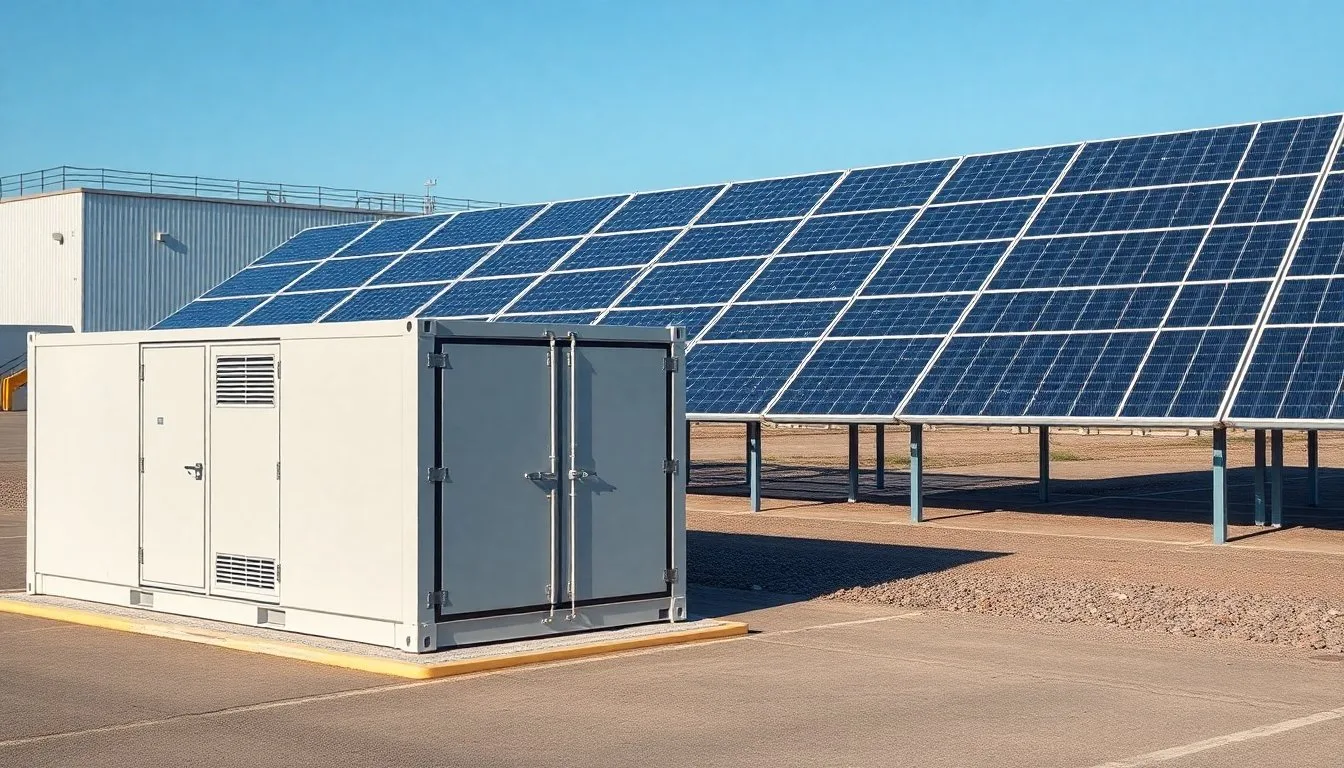
Add a battery when you waste a lot of solar power. Add one too if an outage would cost more than the battery. If your site already uses most of its solar output as it is made, the battery mostly adds cost, since there is little surplus to store. The only reliable test is to model your own half-hourly meter data, with and without storage.
Batteries are now a routine line on solar quotes. The sales pitch is usually “store the surplus and avoid peak charges”. Sometimes that holds, but often it does not, because every site differs.
What a battery actually does for you
A battery shifts electricity from when it is made to when you want it. Because of that, it earns money in only a few ways:
- It stores surplus that would be exported cheaply, and uses it later in place of imported power.
- It reduces what you import when network charges are high.
- It keeps critical equipment running during an outage.
Each of those is worth a different amount on a different site. None has a fixed value per kWh stored, since prices and demand vary.
When storage tends to earn its keep
- The gap between import price and export price is wide. The Smart Export Guarantee lets each licensed supplier set its own rate, as long as it stays above zero, according to Ofgem. When you pay far more to import than you get paid to export, each kWh you store and use later is worth the difference. Our guide to the Smart Export Guarantee shows how to compare tariffs.
- Your demand falls outside daylight. Sites with early-morning or evening peaks, such as some retail units, schools with after-hours use, or shift patterns, send solar power out at midday and buy it back at night.
- A power cut is costly. Cold storage, server rooms, life-safety systems and livestock buildings can justify storage on resilience alone.
- Network charges bite in set hours. Distribution charges often vary by time of day. The bands differ between network operators, and the charging rules have been reformed in recent years, so use your own operator’s current charging statement and your own bills. Do not rely on a rule of thumb from an old brochure.
When it is mostly added cost
- You already use most of what you generate. A warehouse, factory or cold store with a heavy, steady daytime load may leave little surplus to store.
- Your export rate is decent. If the surplus already earns a fair price, there is less to gain by holding it back.
- Your peak-hour charges are small. Lower-voltage sites can face much smaller time-based charges.
- You have no resilience need. A short outage that only inconveniences you is hard to price against a large battery.
In those cases the money may do more in a bigger array or in efficiency work. A battery would add cost without much value. While some sites need storage, others do not. Our guides on solar for warehouses and cold storage cover sites where daytime use is already strong.
An old claim to ignore: “avoid the Triad”
Some older pitches still promise savings by dodging the three highest-demand half-hours of the year. However, Ofgem’s Targeted Charging Review decided that residual network charges would be fixed charges for all households and businesses. If a proposal leans on Triad avoidance, ask the supplier to show the current rule.
An illustrative example
The numbers below are made up to show the method. They are not a quote or a forecast, although the steps are real.
Assume a site would otherwise export 30 kWh of surplus on a sunny weekday. The rest of its power is used on site. Assume it imports at 25p per kWh and exports at 8p per kWh. A battery stores all 30 kWh and loses 10% on the way. That leaves 27 kWh of imports avoided.
- Value of imports avoided: 27 kWh at 25p is £6.75.
- Value of export given up: 30 kWh at 8p is £2.40.
- Net gain for that day: £4.35.
Now multiply by the days when surplus really occurs. The answer will be far lower than 365 times £4.35, because winter days have little surplus. Then compare the yearly total with the installed cost and the battery’s warranted life. That sum decides it, and it changes a lot if you change the two prices.
Other things to check
- Warranty and degradation. Check the warranted cycles and the capacity left at the end of the warranty.
- Fire safety and insurance. Tell your insurer before installing. See what changes on your commercial solar policy.
- VAT and tax. Treatment depends on the project. Start with our article on VAT on commercial solar installations and confirm with your accountant.
- Existing Feed-in Tariff site. If you add storage to an old accredited array, you must tell your FIT licensee. See what happened to the Feed-in Tariff.
Test it before you buy
Run the solar-only case and the solar-plus-storage case on your own half-hourly data. Use your real import and export prices. Our energy and ROI modelling service does this, and a feasibility study covers the wider design. We have no batteries to sell, so the answer follows the numbers, even when it is “not yet”.
Before you buy a battery, test it against your own meter data. Our energy and ROI modelling runs the case with and without storage, since the answer often turns on tariff and load. A feasibility study checks the space and the grid. If you buy, procurement and tender support keeps quotes comparable, and PPA and financing advice covers funded options.