Regional guides for farm and land solar
Farm size, planning rules and the network operator all change from region to region. Each guide uses official farm statistics, modelled yield and the operator's own reports.
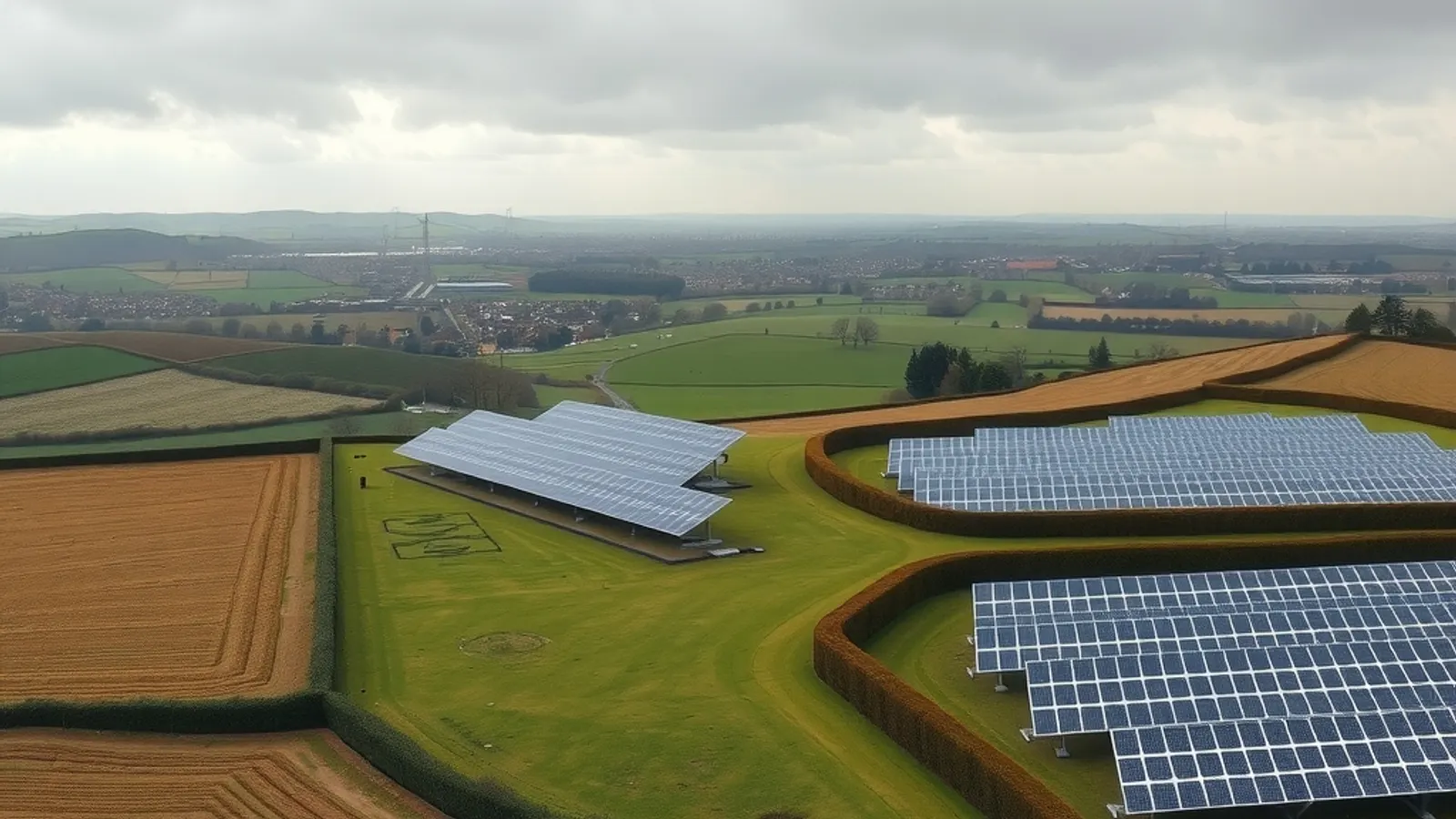
Six regions at a glance
| Region | Network operator | Yield, kWh per kWp a year | Large-scheme consent |
|---|---|---|---|
| South West England | NGED | 1,052 (Exeter) | Over 100 MW: Secretary of State |
| East of England | UK Power Networks | 1,083 (Ipswich) | Over 100 MW: Secretary of State |
| Yorkshire & the Humber | Northern Powergrid | 969 (York) | Over 100 MW: Secretary of State |
| Midlands | NGED | 1,020 (Northampton) | Over 100 MW: Secretary of State |
| Wales | NGED and SP Manweb | 1,042 (Cardiff) | Welsh consenting routes |
| Scotland | SSEN and SP Energy Networks | 904 (Edinburgh) | Over 50 MW: Scottish Ministers |
Yield: PVGIS 5.3, south-facing at 35 degrees with 14% losses, one town per region. Your site will still differ, because shading and tilt vary.
South West England
Dairy country, where milking load and a busy network shape the case.
Cornwall, Devon, Somerset, Dorset, Wiltshire and Gloucestershire: dairy and grazing farms, and a network already full of solar and battery projects.
View region →East of England
Large arable farms, where yield is strong yet the transmission network is the limit.
Essex, Suffolk, Norfolk, Cambridgeshire, Bedfordshire and Hertfordshire: big arable holdings, strong yield and a transmission network under pressure.
View region →Yorkshire & the Humber
Cereal land to the east, livestock to the west, heavy industry on the estuary.
North, East, South and West Yorkshire and northern Lincolnshire: mixed farming alongside the Humber's ports and process industry.
View region →Midlands
Arable fields in the east, small farms in the west, logistics along the M1.
Lincolnshire to Herefordshire: large arable holdings in the East Midlands, the smallest farms in England in the West Midlands, and a logistics corridor between.
View region →Wales
Hill and grassland farms, while Wales has its own best-land policy.
Powys, Ceredigion, Carmarthenshire, Pembrokeshire, Gwynedd, Monmouthshire and the Vale of Glamorgan: upland sheep farms, a Wales-specific rule for good land and two network operators.
View region →Scotland
A separate consenting system, while yields are the lowest in Britain.
Perthshire, Angus, Fife, Aberdeenshire, the Borders, Dumfries and Galloway and Ayrshire: a separate planning system, two network operators and lower yields in the north.
View region →Land outside these regions?
Tell us the county and what you hold. The method stays the same, because only the local facts change.