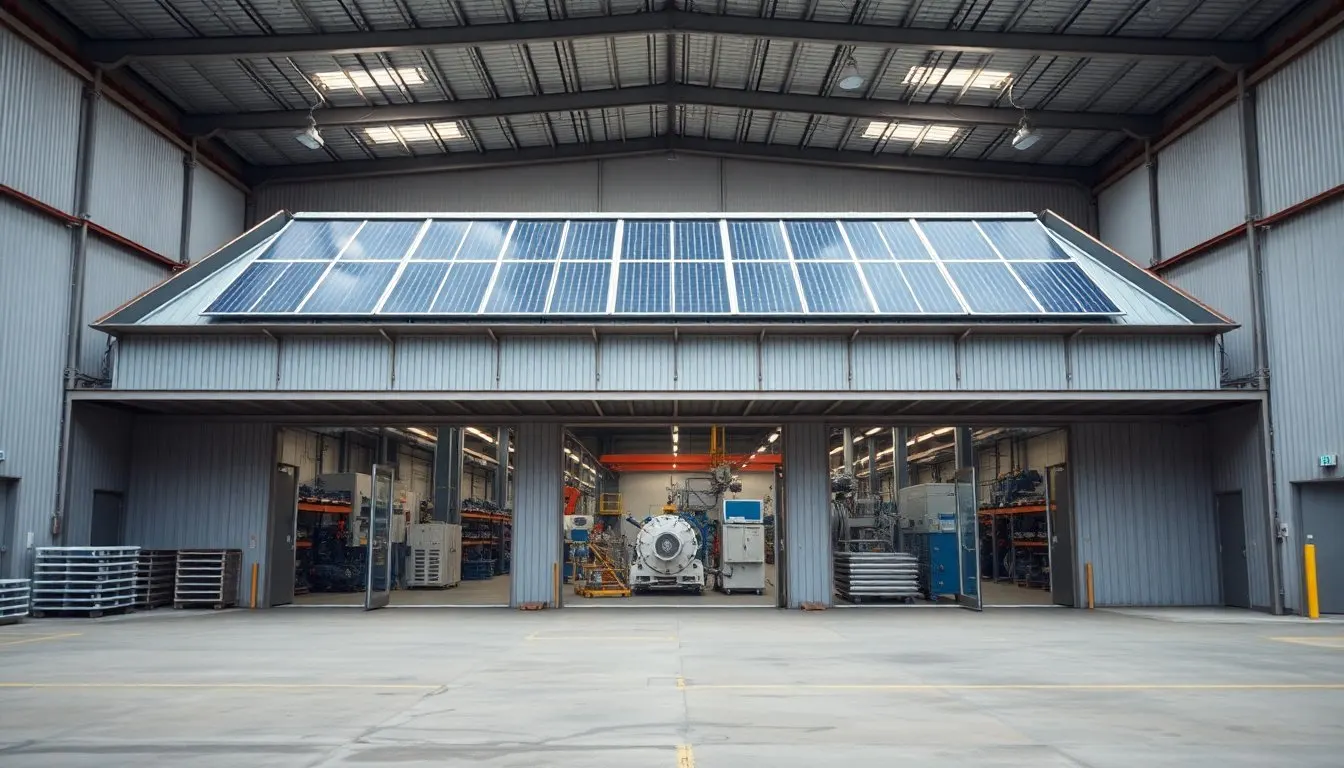
A factory should size its solar array to the power it uses during daylight, not to the area of its roof. A site with one day shift can use most of what its panels make. A site running three shifts uses a great deal of power at night, when panels make none, so the same roof earns less. Compressed air, motors and any electric process heat shape that daytime load, which is why a factory needs its own analysis.
Warehouses are simpler, because their load is mainly lighting, charging and handling equipment, spread across the working day. A production line has plant that starts, stops and cycles with what is being made. The way to find out what your plant needs is to start from the meter data, not the roof plan.
Why load matching matters
Solar earns most when it replaces power you would otherwise buy at the full price. Power exported to the grid earns the lower export rate, as our guide to the Smart Export Guarantee explains. A day-shift plant that works roughly 8am to 4pm lines up well with the sun for much of the year. A continuous plant does not.
An illustrative comparison
The numbers below are made up to show the logic. They do not describe a real site.
| Assumption | Day-shift plant | Three-shift plant |
|---|---|---|
| Annual electricity use | 2,000 MWh | 2,000 MWh |
| Share of use between 8am and 4pm | 70% | 38% |
| Array sized to the daytime load | Larger | Smaller |
With the same total use, the day-shift plant has far more demand under the sun. A roof that suits it would oversupply the three-shift plant on quiet days. Your own half-hourly data replaces these guesses.
Compressed air
The Carbon Trust says compressed air accounts for about 10% of UK industry’s electricity use. It calls fixing leaks the most important saving for most businesses, and says a single 3mm hole can cost roughly £1,000 a year in electricity. It also says reducing pressure by 10% saves about 5% of the energy.
Compressors often run through the working shift, so they make a steady load that solar can cover. But fix the system first. If you cut leaks and pressure after the solar is sized, the load shrinks and the array becomes too big. Size the array on the leaner, repaired system.
Process heat
Panels make electricity, not heat. A gas furnace or steam boiler cannot run on solar until it is replaced or converted. Legal commentary from Bevan Brittan puts UK industrial process heat at about 170 TWh a year, around a quarter of UK heat demand. It says heat below 150°C suits electrification with heat pumps.
Be careful with that range, because a heat-pump research network notes that commercially available industrial heat pumps are limited to supply temperatures below 100°C. Washing, drying and low-temperature heating are the likeliest candidates. High-temperature furnace heat is a different problem.
Where heat has already been electrified, or will be, it becomes a load that solar can serve. That changes the self-consumption case, but electrifying heat also raises your peak demand and may need a bigger grid connection. Plan both together.
Which loads match the sun?
| Load | Typical pattern | Solar match |
|---|---|---|
| Compressed air | Steady through the shift | Strong |
| Electric low-temperature heat | Follows production hours | Strong |
| Motors, conveyors and extraction | Follows the shift pattern | Strong on day and two-shift sites |
| Refrigeration | Near-continuous | Moderate, see our cold storage guide |
| Lighting, general power | Follows occupancy | Strong on day shift |
| Gas-fired high-temperature heat | Continuous, not electric | None directly |
Three-shift sites
A continuous factory can still gain from solar. The usual approach is a smaller array sized to the afternoon load, or batteries that move some midday output into the evening. Batteries add cost, so test them against the real overnight load, not an assumption. Our guide to commercial solar battery storage shows how that trade-off is modelled.
Energy prices and support schemes
The value of each kilowatt-hour you displace depends on your own contract, so use your latest bill and any fixed-price terms, not a national average.
Two government schemes change the baseline for some manufacturers, per the GOV.UK announcement:
- The British Industry Supercharger raised the discount on network charges from 60% to 90% from 1 April, for around 500 of the most energy-intensive firms.
- The British Industrial Competitiveness Scheme will cut eligible bills by up to 25% from April 2027, for more than 10,000 manufacturers. Relief is set site by site, based on how much of the electricity goes into eligible products.
Neither scheme changes how solar works. They do lower your baseline price, which lengthens the payback on any project that displaces power. Check whether you qualify before you model returns.
Tax works differently from what many sales pitches imply. HMRC’s manual designates all capital spending on solar panels as special rate, so the full expensing relief for main-rate plant is not available for them. The Annual Investment Allowance, currently £1 million a year, may help, though a busy plant budget can use it up first. Ask your accountant to model the real after-tax cost. Our piece on the full expensing mistake explains the trap.
Grid connection
A factory often has a large supply, but large solar still needs a network operator’s approval under the G99 process. Our G99 guide sets out the steps. Ask early, particularly if you plan to electrify heat as well.
How to test your own plant
Start with a year of half-hourly meter data. Overlay your shift pattern. Mark compressed air, motor, heat and cooling loads, and note which are already electric. Then repair leaks and decide on any heat changes, and only then size the array and any battery to what the site can absorb in daylight.
That is what an independent feasibility study does: metered load analysis, generation modelling and a grid check, run together. It gives an honest estimate of self-consumption before you commit capital. Our work for industrial and manufacturing sites follows the same route, and our guide to solar for warehouses and logistics covers the simpler shed case.
Since the right size depends on your shift pattern, start with meter data. A feasibility study checks the roof and grid. Energy and ROI modelling matches the array to daylight load, while our net zero strategy work places solar beside heat electrification. Procurement and tender support then keeps installer bids comparable.