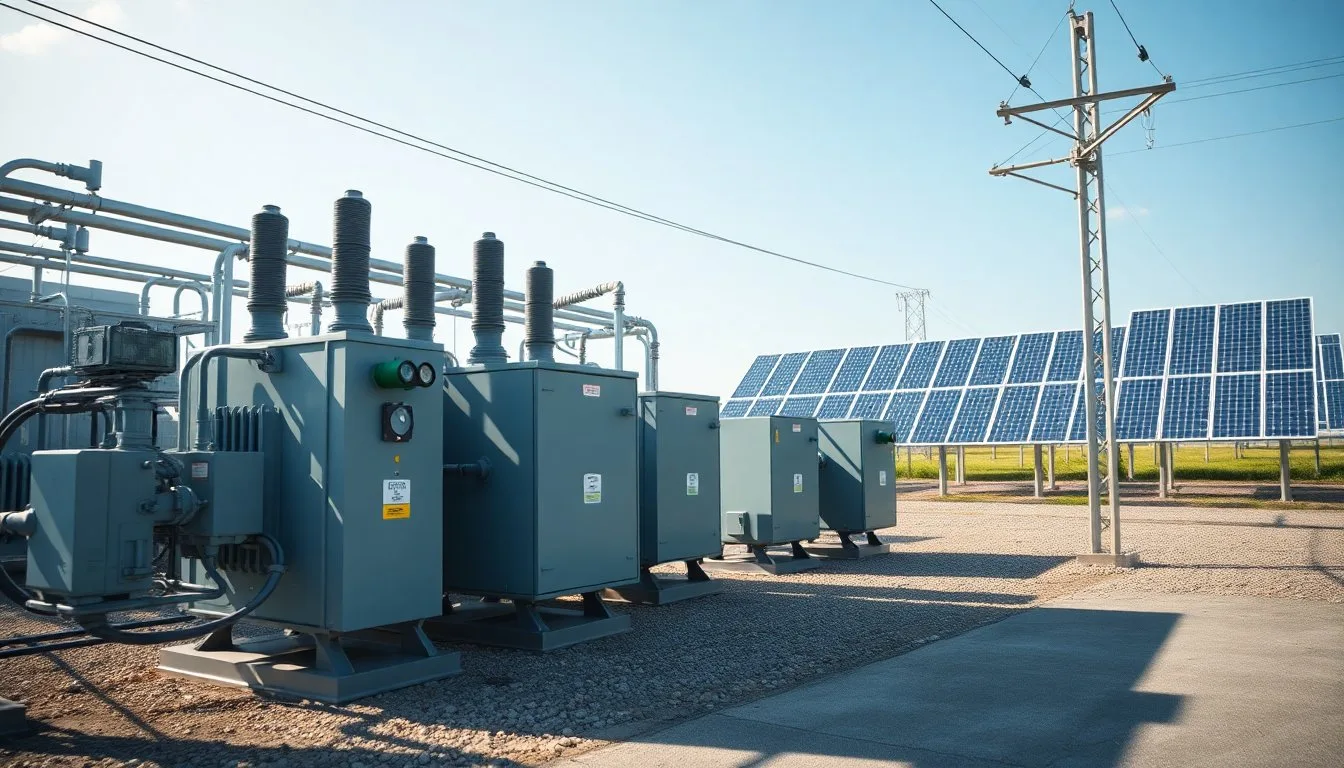
G99 is the rulebook your local network operator uses to approve a solar system that is too big for the simple notification route. If your system’s output goes above 16 amps per phase, you must apply to your distribution network operator (DNO) and get its approval before you connect. For commercial solar that is almost every project. This guide explains what G99 asks for, how the size bands work, and where the delays tend to come from.
G98 or G99: where the line falls
Engineering Recommendation G98 covers small generators. The limit is 16 amps per phase, which works out at about 3.68 kW on a single phase or about 11 kW across three phases. For these, you can usually connect first and tell the DNO afterwards.
Anything bigger falls under G99. The order flips: the DNO must assess and approve the connection before it is energised. Electricity North West describes G99 as the route for generators connecting to its network after 27 April 2019, and its application form asks for extra detail for modules of 150 kW or more.
The limit applies to the inverter’s rated output, not the number of panels. A typical commercial roof system is many times over the line.
The four generator types
G99 sorts generators into Types A to D. Size and connection voltage decide which one applies. The bands below come from the network operators’ own guidance, such as SSEN’s generator types document.
| Type | Registered capacity | Typical project |
|---|---|---|
| A | 0.8 kW up to (not including) 1 MW, below 110 kV | Most commercial rooftops |
| B | 1 MW up to (not including) 10 MW | Large roofs, small ground-mount arrays |
| C | 10 MW up to (not including) 50 MW | Solar farms |
| D | 50 MW or more, or any size at 110 kV or above | Transmission-scale schemes |
The legal source for the categories is article 5 of the EU Requirements for Generators Regulation as it applies in Great Britain. It sets Type A at 0.8 kW and sends the other thresholds to the Grid Code. Higher types face more technical requirements, more studies and often witness testing.
A typical business rooftop is Type A, while a large roof or a ground-mount array may reach Type B.
The process, step by step
Every DNO has its own portal and forms, although the stages are broadly the same.
- Early enquiry. Ask the DNO whether there is room for your size of system at the nearest substation. Check whether your DNO publishes a capacity map, as that gives a first idea before you spend on design.
- Application. You send the standard G99 form, a single-line diagram, a site layout and inverter data with its type-test evidence. Missing paperwork is a common reason for delay, because the clock only starts once the application is complete.
- Assessment. The DNO checks what your output does to the local network. It looks at voltage, fault levels and protection. If the network cannot take the export, it may offer a smaller connection, an export limit or a reinforcement scheme at your cost.
- Offer and acceptance. The DNO issues terms. You accept, pay any charges and book the works.
- Commissioning. After installation you notify the DNO. It may witness protection tests before the system exports.
How long does it take?
There is no single answer, but there are published benchmarks for how quickly a DNO must respond. Ofgem’s March 2026 letter on payment levels lists performance standards for generation quotations. A low-voltage generation quotation is due within 45 working days, and a high-voltage one within 65. A budget estimate is due within 10 working days for connections under 1 MVA and 20 working days for 1 MVA and over. A DNO that misses a quotation standard makes a voluntary payment.
Those are response times for a quote. They do not cover reinforcement works, which can add many months, nor the build once you accept. Treat them as a floor, not a forecast. Our guide to how long a commercial solar installation takes puts the grid stage in the context of the whole programme.
Where cost and delay come from
Three things move a G99 project more than anything else.
- Local headroom. A network built to deliver power outwards to small loads has limits on what it can absorb. Rural feeders are the usual trouble spot, and we cover that in rural grid connections for farms.
- Export size. A system that uses most of its output on site may be able to accept an export limit instead of expensive reinforcement. This is one reason the load profile matters as much as the roof area.
- Application quality. A complete, correct pack avoids rounds of questions.
Wider reform of the connections queue is under way, and it affects timing for larger schemes. Our briefing on UK grid capacity in 2026 explains what has changed and what has not.
What to do before you commit
Ask for the grid answer first. A capacity enquiry usually costs little, while a connection surprise after a tender can cost a lot. Check the DNO’s published timescales for your region, and write the likely connection date into the programme rather than hoping for the best.
Also choose the system size with the connection in mind. A smaller array that fits the available capacity can beat a bigger one that waits two years for reinforcement.
Our feasibility studies include the grid enquiry alongside the roof survey and yield modelling. If you want a view on what a study covers, read what a commercial solar feasibility study involves.
The grid answer shapes everything else, so ask early. A feasibility study includes a capacity check and sizes the array to fit. Energy and ROI modelling shows what a smaller connection does to payback, while procurement and tender support makes sure installers quote for the same connection. On a multi-site estate, portfolio optimisation orders sites around connection dates.