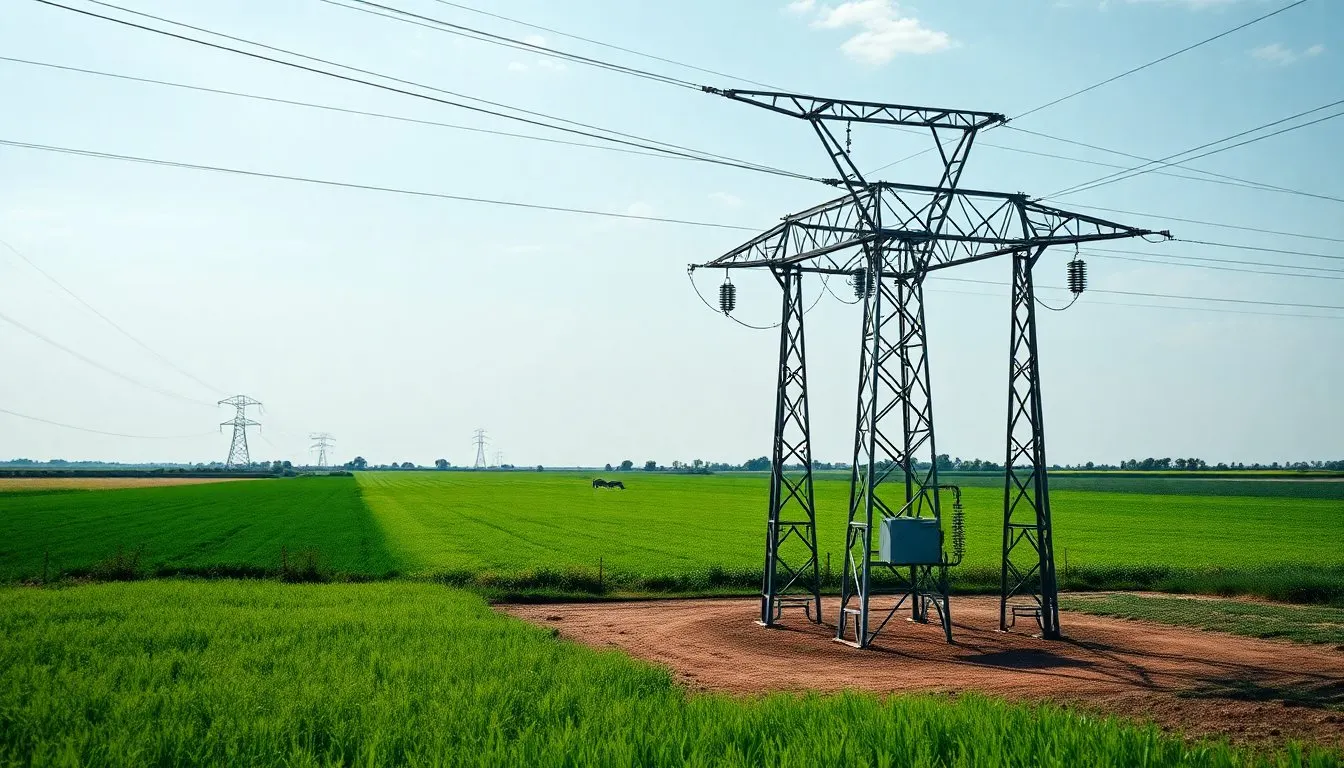
Farm solar projects often wait longer for a grid connection than similar projects in towns. The cause is physical, not clerical. Farms sit at the end of long rural lines built to carry power out to a few buildings, not to take it back. Many have a supply that is too small for a large array. And the nearest substation may have little spare room for generation.
The farmers feel it. A survey of 271 farmers, landowners and tenants by Solar Energy UK found grid connection was the most common barrier, named by 34%, ahead of planning at 20%. This article explains why, what you can check before spending money on design, and how to plan for the wait.
Why rural lines have less room for generation
Distribution networks grew up to push power out from substations to customers. Rural lines are long and often have a single route in. Fewer customers share each line, so there is less demand nearby to soak up what a solar array produces at midday.
When an array exports on a long, thin line, the voltage at the far end can rise too high. The network operator (the DNO) has limits on voltage and on fault current. A 250 kW array on a quiet rural spur can hit those limits where the same array on a busy industrial estate would not.
This is general network engineering, not a rule for every farm. Some rural substations have plenty of room. The point is that you cannot assume it.
G98, G99 and where your farm falls
Small systems use a simpler route. Under the engineering standard G98, a system up to 16 amps per phase can be installed and then notified. Western Power says G99 applies above 16 amps (3.68 kW) per phase, or where a system does not meet G98. That is roughly 3.68 kW on a single phase and about 11 kW across three. An inverter rated just over the line, such as 4 kW on a single phase, tips the system into G99.
G99 sorts generators into types by size. A “Type A” module runs from 0.8 kW up to 1 MW. Type B runs from 1 MW to under 10 MW, as set out in the ENA’s G99 text hosted by National Grid. Network operators ask for the full application form for Type A modules above 50 kW, and for all larger types (SSEN’s form says so). Most farm rooftop schemes fall in Type A. Most ground-mount farm schemes of a megawatt or more fall in Type B or above.
Our plain guide to G99 covers the steps in order. Here we focus on why farms struggle.
The supply to the building can be the first obstacle
Many older farm buildings were wired for lighting and small motors. Some still run on a single-phase supply. Under the G98 limit above, a single phase carries far less than three phases before formal approval is needed. If the array you want is large, you may first need a three-phase supply.
Ask your DNO what the upgrade would involve and what it would cost. On a remote holding, the work may mean a long new cable run. Get this quoted at the same time as the generation enquiry, not after.
What “reinforcement” means in practice
If the DNO’s study finds a problem, the fix is construction work. It could be a larger transformer, a new cable back to a stronger point on the network, or new protection equipment to handle higher fault current. Each takes design, permission and a crew.
On a busy network, a small reinforcement is spread across many customers over time. On a quiet rural spur, there may be no nearby capacity to build from. Treat any cost estimate with caution until you hold a formal quote.
How to check headroom before you design
Network operators publish capacity maps. National Grid’s network capacity map for its distribution areas shows generation headroom at larger substations and uses colours to show where a connection is more likely to succeed without major reinforcement. Other DNOs publish their own versions.
Read the map as a hint, not a promise. The operator itself says the data is only an indication, comes from a statement updated every six months, and does not replace a formal application. A red substation may still accept a connection, but it may need major reinforcement.
Use the map to decide how hard to push. Red or amber suggests designing a smaller or self-supply system, or budgeting for reinforcement from the start. Green means you can reasonably go to a formal application.
Is the national queue reform helping?
The connections reform run by NESO, approved by Ofgem in April 2025, changes how projects get a place in the queue. The NESO overview says it aims to let only projects that are ready and fit strategic criteria move forward with a firm date. It involves the DNOs for distribution-connected projects. Our guide to grid capacity in 2026 covers the national picture.
What we cannot tell you is exactly how the reform treats a small farm scheme. The sources we found do not say that small G98 or G99 systems are exempt. Ask your DNO how it applies to your application. And remember that no queue rule adds cable to a line that is already at its limit.
Practical steps for a farm
- Ask for an informal capacity check first. Ask your DNO whether it offers a basic enquiry before a formal application, what it charges and how long it takes.
- Check your supply type. Find out if you are on single phase, and what a three-phase upgrade would cost.
- Size for your own use where headroom is thin. A system built to use its own power on site, with little or no export, may avoid the studies that trigger reinforcement. Confirm that with the DNO, because the rules for export limits differ by network.
- Plan on a slow timeline. Build the payback model on the DNO’s quoted dates, not a hopeful guess. Our piece on how long a commercial solar installation takes shows where connection fits in the whole programme.
Putting it together for your holding
None of this means farm solar does not work. Many farms generate and export successfully. It means the grid question belongs at the start of the project, next to roof or land suitability and the money case. If you are also weighing a lease against self-supply, see our guide to land leases versus on-site solar and our summary of what landowners are paid.
Our work for agriculture and land owners puts the connection check inside the feasibility study, because on a farm it is often the question that decides whether the numbers hold.
Since the grid decides most farm schemes, check it before anything else. A feasibility study asks the network operator first. Energy and ROI modelling tests a smaller or export-limited array, while PPA and financing advice compares funding routes. For several sites, portfolio optimisation puts the ones with grid access first.