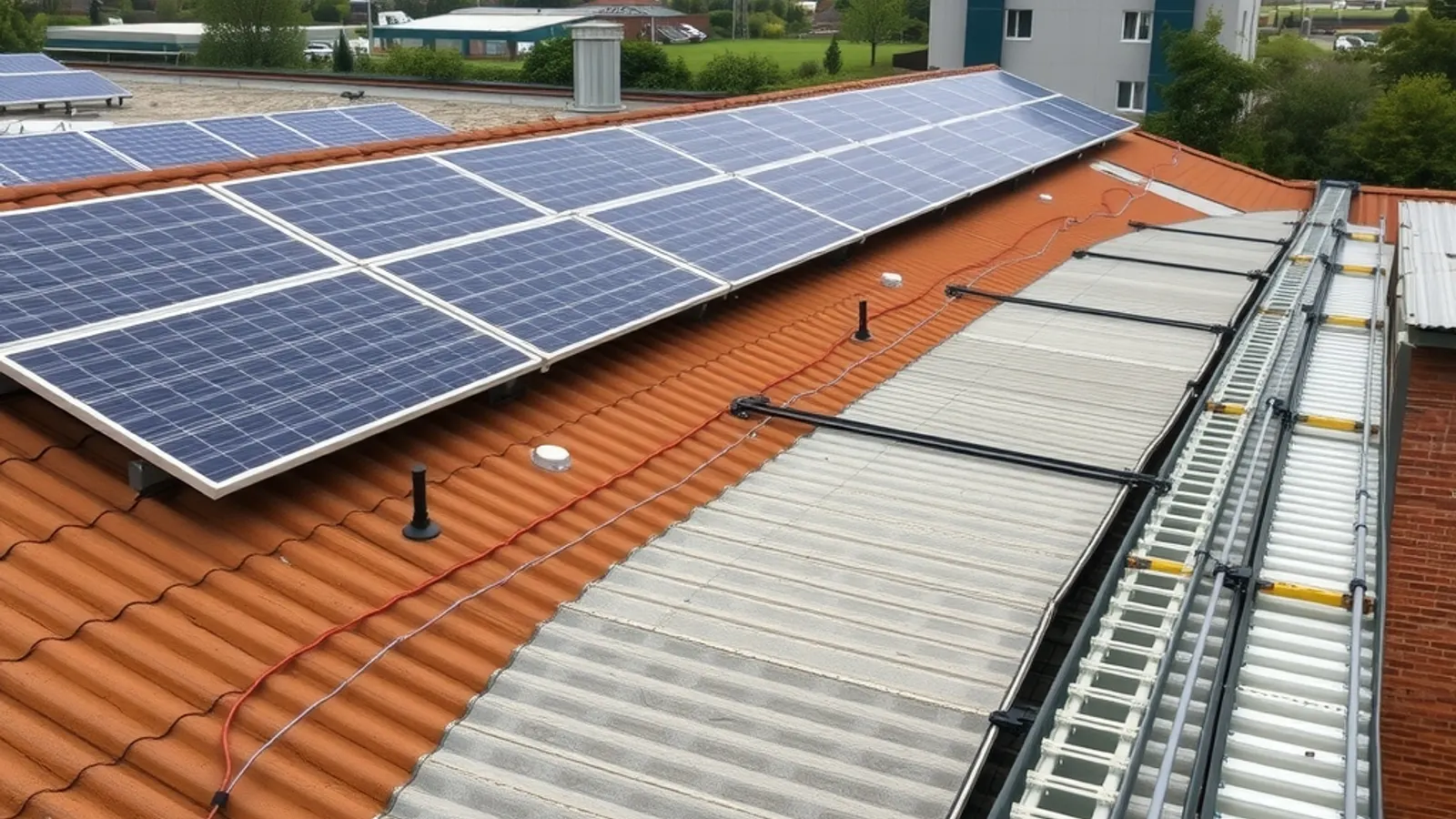
The panels are the quick part, since fixing them to a roof takes days or weeks, depending on size. What takes months is everything around it: the study, the planning check, the tender, and above all the grid connection. No official body publishes an average end-to-end time for UK commercial solar, so we will not give you one. This article sets out which parts of the timeline are fixed by rule, which depend on your site, and how to build a programme you can test against real quotes.
The stages, in order
A typical single-site project passes through these stages.
- Feasibility. A desktop review, a roof or land survey, shading and yield modelling, and an early grid enquiry. Our guide to what a feasibility study involves lists the parts.
- Business case. Costs, tax relief and funding route, built on your own half-hourly data.
- Planning check. Often a prior approval application for a rooftop, or full planning for a field.
- Procurement. Specification, tender, bid comparison and contract.
- Grid application. The G99 process with your network operator.
- Installation and commissioning.
- Switch-on and export.
Several of these can overlap. The grid application, in particular, should start long before the tender ends.
What is fixed by rule
A few time limits are written down.
- Rooftop planning. For non-domestic roof solar under permitted development, the council assesses design and glare through prior approval. If it does not respond, work may start after 56 days. The same page excludes listed buildings, so those need a different route.
- DNO quotations. Ofgem’s guaranteed standards letter of March 2026 lists 45 working days for a low-voltage generation quotation and 65 working days for a high-voltage one. The network operator pays a voluntary sum if it misses them. These are response times for the quote only.
- MCS. The MCS standard MIS 3002 covers systems up to 50 kWp. Larger systems are outside it, so commissioning checks follow the installer’s contract and the DNO’s rules instead.
Nothing in these rules covers how long network reinforcement takes, how long a roof repair takes, or how long equipment is on order. Those are site and market questions.
What stretches the programme
The grid. This is the biggest swing factor. A site with spare local capacity gets a straightforward offer. A site on a crowded feeder may need network works, and the DNO decides how long they take. The wider connections reform affects timing for some schemes too, and we cover it in UK grid capacity in 2026. Our G99 guide explains the steps.
The roof. An old roof without drawings needs an engineer to assess it from scratch. A failing covering may need replacing first. Asbestos cement sheets add survey and handling steps. See roof surveys, loading and asbestos.
Procurement. A rushed tender with a loose specification saves a few weeks and costs far more in weak contract terms. A clear, output-based brief makes bids comparable. Our procurement and tender support covers how this is run.
Equipment lead times. Panels, inverters and transformers are ordered after contract, and their delivery dates move with the market. Ask each bidder to state the lead time in writing.
An illustrative programme
The table below is a planning template, not a statistic. The durations are assumptions for a mid-sized rooftop system on a site with no unusual problems. Replace each one with a figure from your own DNO, installer and engineer.
| Stage | Assumed allowance | What could change it |
|---|---|---|
| Feasibility and business case | 1 to 2 months | Roof with no drawings, complex tariff |
| Planning prior approval | Up to 56 days, in parallel | Conservation area, objections |
| Tender and contract | 1 to 2 months | Specification not ready, poor bids |
| Grid quotation and offer | Up to 45 or 65 working days to quote, then your acceptance | Studies, reinforcement |
| Equipment delivery | Set by supplier quote | Market conditions |
| Installation | Days to a few weeks | Weather, access, roof repairs |
| Commissioning and export | Days to weeks | DNO witness testing, meter work |
Add them up, then add a margin for the grid. If the DNO calls for reinforcement, put the DNO’s own date, not an optimistic one, in your plan. That single date can add months.
Four ways to protect your timeline
- Open the DNO enquiry on day one. It costs little and it starts the slowest clock.
- Do the structural check before you specify. Surprises on the roof are cheapest to find early.
- Tender against one clear specification. Bidders then price the same job.
- Keep the planning route in view. Check whether your roof or car park is listed or in a conservation area before you promise a start date.
If you are still weighing up a canopy or ground-mount scheme, read ground-mount vs rooftop solar, because planning and land questions add stages that a roof does not.
Getting your own timeline
A generic estimate is only as good as the site it assumes. Our feasibility studies include the grid enquiry and the structural view together, so the report gives you a dated range for your own site. If you want to see how long a project is likely to run and what it will cost, how much commercial solar costs is the natural next read.
Timelines slip at the grid and in procurement, so plan those first. A feasibility study starts the grid enquiry early, while procurement and tender support runs a tender with dates you can hold installers to. Energy and ROI modelling shows what a delay costs, and portfolio optimisation staggers a multi-site rollout.