Land lease or on-site solar — which is right for you?
You can make and use the power yourself, or rent a field to a developer for a fixed, index-linked rent. Neither is right by default, because it depends on your capital, your appetite for risk, and what you need the land to keep doing.
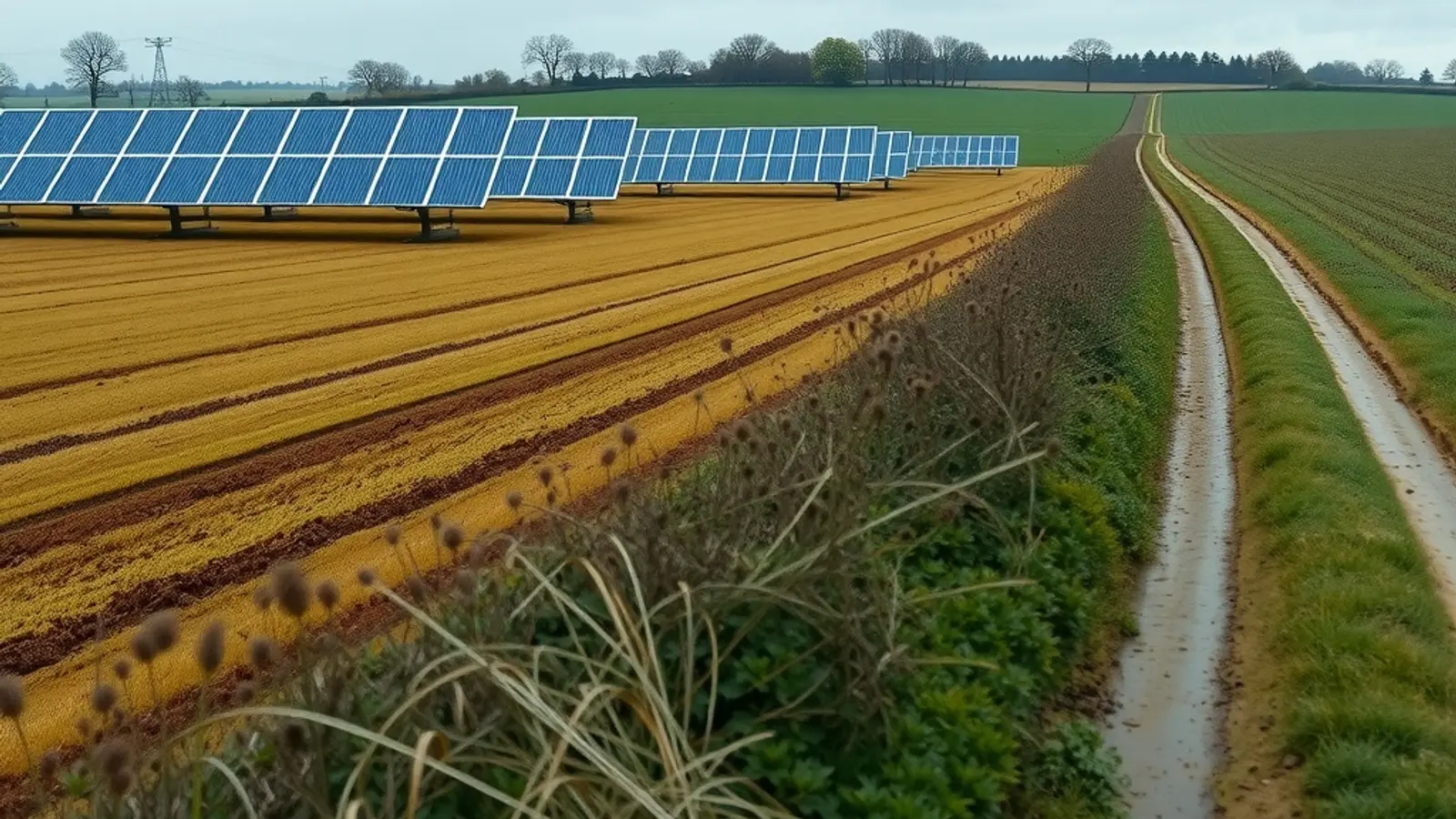
Sooner or later, most farms with big roofs or a spare field get the call. A developer wants to lease land for a solar farm. Or a supplier wants to sell you a system for your own use. Yet it sounds like the same conversation.
They aren't.
Making your own power keeps you in the business of using and selling electricity. You pay for the system, or you finance it. Either way, the roof or field keeps doing its old job, while it makes power on top.
Leasing land to a developer takes you out of that business almost entirely. You put in no capital and carry no running risk. But the lease ties the land to one use, at one rent, for a long time. It will likely outlast your current plans for the farm, since terms run for decades.
Both can be the right decision. Still, they suit different farms, and this guide sets out how to choose between them.
The two paths
Self-supply and export
You fit a system sized to your buildings and your demand, or a funder does it for you under a PPA or lease. The power covers your own use first, because a unit you don't have to buy is worth the most. You sell any surplus to the grid under Ofgem's Smart Export Guarantee, which covers sites up to 5MW.
- You keep the land or roof in its current use, plus generation on top
- Return depends on your own tariff, load profile and the capex you fund
- You (or your funder) carry performance, maintenance and market risk
Lease the land to a developer
A developer takes an option on the land, wins planning and a grid connection, then builds and runs a much larger array. It is often tens of megawatts, on land you no longer farm. You become a landlord, not a generator. You get a fixed rent, usually linked to inflation, for a term that often runs 25 to 40 years.
- No capital outlay and no generation, performance or market risk
- Guaranteed rental income, largely protected from inflation by indexation
- The land is out of agricultural use, and largely out of your control, for the lease term
The real trade-offs
Certain income or control. A land lease is about as close to risk-free income as farming gets. The rent doesn't move with the weather, power prices or your own choices, because the developer carries all of that. Making your own power is a real business by contrast.
Its return depends on tariffs, when you use power and how well the system runs. You, or your funder, carry that risk. What you gain is control. The land keeps doing what you need, and the system is yours to change or sell.
Losing land or risking capital. A lease gives up the land for a generation. Developers want the flatter, better-connected fields, although these are often your best. At the end, you get the land back under a bond and a duty to restore it. Making your own power risks capital instead.
That capital is yours if you buy, or a funder's if you take a PPA. Either way, the land stays in your hands, in whatever use you choose.
What the rent is really worth. Rural surveyors publish benchmarks that put solar rents well above normal farm rents. The exact figure moves with the site, how close the grid is, and how well you negotiate.
Savills' research on renting land for renewables cites an industry-quoted figure of around £2,500 per hectare a year for large solar leases. That is roughly £1,010 per acre.
Strutt & Parker's rural team has noted many solar rents settling nearer £950 per acre. That compares with £150 to £200 per acre on a typical Farm Business Tenancy. The rent is usually linked to inflation, over a term that can run to 40 years.
However, treat these figures as a place to start talks, not a fixed price. Larger, flatter sites close to the grid can ask for more.
Tax pulls the other way. Land you farm yourself, or let on a Farm Business Tenancy, usually qualifies for Agricultural Property Relief from inheritance tax. Once it is let for solar, it is no longer in farming use.
So you usually lose that relief, as Savills' analysis notes. Still, that doesn't make leasing wrong. It does mean you should model it, next to the rent, before you sign.
How agrivoltaics changes the calculus
Handing over the land or farming it are not the only choices. Agrivoltaics, for example, keeps the land in farming use alongside the panels. In the UK, the common version is sheep grazing under a standard array. That is why grazing deals and solar leases often now share the same field.
Developers are also trying other designs. Panels set higher, mounted upright or spaced further apart let light and machines through. The aim is to keep some crops viable too. However, these designs are newer and depend more on the site than grazing does.
Where it works, agrivoltaics softens the loss of land. It can also help you in lease talks. A scheme built to keep grazing going is easier to defend at planning, where policy protects the best farmland. Raise it with any developer at the heads of terms stage. Don't wait for them to offer it, since they rarely will.
Grid connection: the same constraint, a different scale
Both routes depend on spare room on the local network, but at very different scales. A system sized to a farm's own use is usually a small or medium connection under the ENA's G98 or G99 rules. Because the size is modest, the path to a connection offer is shorter and more predictable.
A leased site of tens of megawatts sits at the other end. It needs a full G99 study and a formal application to the network operator. Where the network is busy, there may be upgrade costs. There may also be a queue that runs for years, not months, because many schemes are waiting.
That is why a serious developer secures its grid place early. It is also why "we have a connection offer" is a claim to check. Check it for yourself, because a lapsed offer is worth nothing. Don't take it on trust before you sign an exclusivity deal or heads of terms.
Making the decision well
Neither path is right by default. A developer's option letter or an installer's sales survey is not an independent second opinion.
We help farms and landowners test both routes before anything is signed. That means a study of the site itself: its size, its likely output and its grid room. It also means independent advice on the funding and the lease terms, whichever way the numbers point.
Sources & further reading
- Savills Research — Renting and renewables (land-lease rent benchmark, lease terms, Agricultural Property Relief)
- Strutt & Parker Rural Hub — Solar farm offers to landowners need careful thought
- Ofgem — Smart Export Guarantee (SEG)
- ENA — G99 connection guide for Type B–D generation (commercial, industry, developers, farms)
Land lease vs on-site solar: frequently asked questions
Can we do both — lease some land and self-supply from a roof?
Yes. For many farms that is the right answer. Barn and shed roofs can cover the farm's own power use. A separate field can be leased to a developer for a larger array. The two choices don't have to be made at the same time, and often shouldn't be.
Do we lose Agricultural Property Relief if we lease land for solar?
Often, yes, and it is a real part of the choice. Land you farm yourself, or let on a Farm Business Tenancy, usually qualifies for Agricultural Property Relief from inheritance tax. Once it is let for solar, it is no longer in farming use, so the relief is usually lost. Savills' research on renewables leases sets this out. Ask your own tax adviser about it at the same time as you look at the rent.
What happens to the land at the end of a solar lease?
A well-drawn lease makes the developer remove the array and return the land to farming condition. The developer usually backs this with a bond, paid in over the term or set aside at the start. Who holds that bond matters. It is exactly the kind of clause to have checked before you sign heads of terms.
Does a leased solar farm still need planning permission?
Yes. Ground-mounted schemes need full planning permission. In England, schemes above 100MW go through the Nationally Significant Infrastructure Project regime instead. That limit was raised from 50MW by the Infrastructure Planning (Onshore Wind and Solar Generation) Order 2025, in force from 31 December 2025. Either way, the process looks at landscape, farmland quality and the grid. The developer normally leads and pays for it. But the outcome, and any conditions, stay with the land for the whole lease.
Weighing up a land lease or an on-site system?
Tell us about your farm or estate and what the developer or installer has offered. We'll give you an independent read on whether it stacks up — before you sign anything.