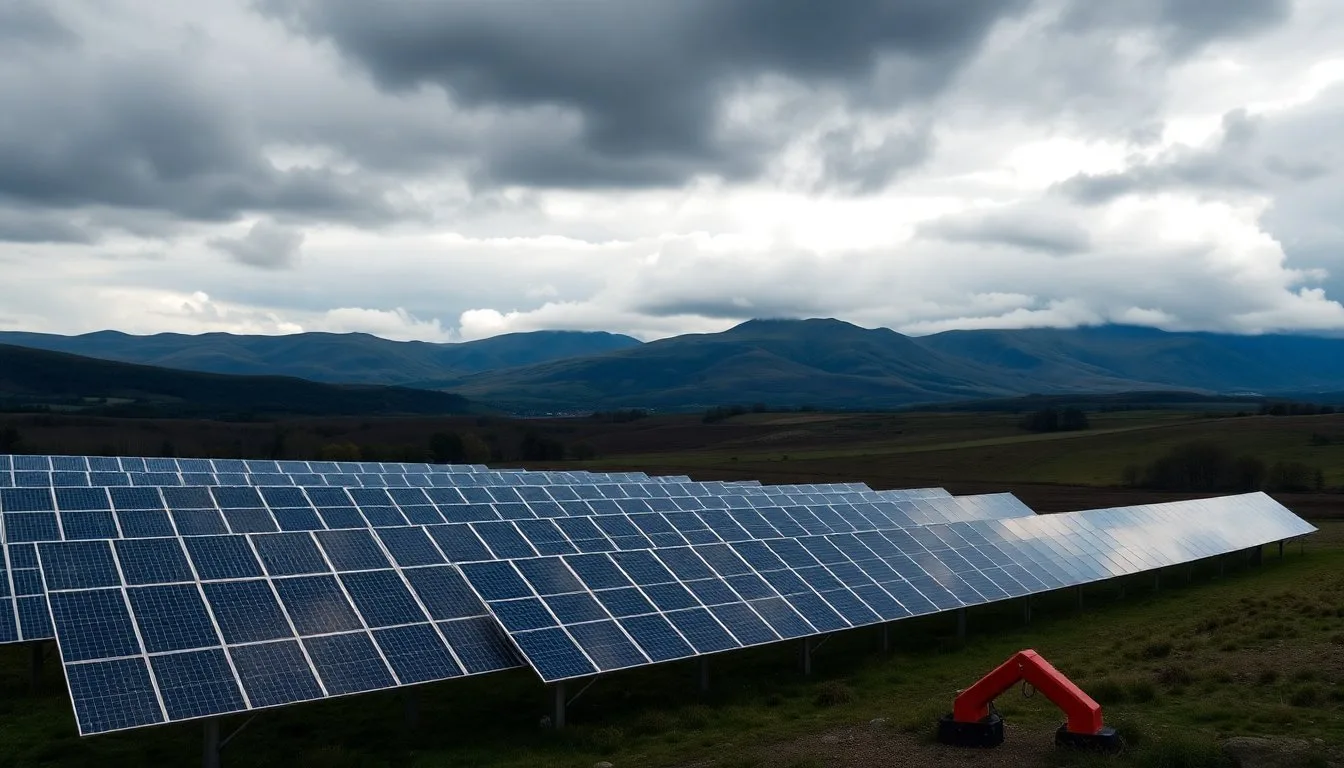
In Scotland, a solar scheme of 50MW or less is decided by the local planning authority. A scheme above 50MW is decided by Scottish Ministers under Section 36 of the Electricity Act 1989, through the Scottish Government’s Energy Consents Unit. The council becomes a consultee, not the decision-maker. That fork shapes your advisers, your timetable and who you negotiate with, so it is worth settling before you sign a lease.
The 50MW line is also under review, as explained below. As of 10 October 2026 we can find no decision to change it.
The two routes
Up to 50MW. The local planning authority decides, under the Town and Country Planning (Scotland) Act 1997. Rooftop and modest farm schemes sit here.
Above 50MW. Scottish Ministers decide under Section 36 of the Electricity Act 1989. The Energy Consents Unit (ECU) handles the case for them. Applications go through the Energy Consents portal.
The Scottish Government’s own consultation papers describe the same split: 50MW or less goes to the planning authority, above 50MW to Ministers.
What makes Section 36 different
One decision covers both consents. When Ministers grant a Section 36 consent, they can also direct that planning permission is deemed to be granted. Section 57(2) of the 1997 Act gives them that power. You do not run a separate planning application alongside it.
The council has a voice, not the vote, although the local authority is consulted and can object. Until recently, an objection from the council automatically led to a public inquiry. That has changed (see the reforms below).
Environmental assessment is part of the application. The Government’s guidance applies to schemes that need environmental impact assessment, which covers most generating stations at this scale.
Community engagement is expected. The Scottish Government’s good-practice guidance says pre-application consultation is not a statutory step for Section 36 applications, but is the minimum expected practice. It asks for at least two public events, with the second at least 14 days after the first. It also asks for a pre-application consultation report with any EIA application.
The steps, in order
The same guidance sets out the stages:
- Pre-application. Complete the ECU’s notification form. The ECU aims to contact you within 21 days to discuss what you need. Engage the council, statutory consultees and the community.
- Environmental impact assessment. Screen the project and, where needed, produce an environmental statement.
- Submission. Lodge the application and supporting documents.
- Processing. The ECU consults the council and others.
- Inquiry, if one is needed. It may be held by the Directorate for Planning and Environmental Appeals.
- Decision. Ministers decide, including whether to deem planning permission granted.
The guidance gives no fixed deadline for the whole process. A contested case takes longer than a clean one, so early and honest engagement pays off.
Reforms already in force
The Planning and Infrastructure Act 2025 received Royal Assent on 18 December 2025. Law firm Brodies summarises the Section 36 changes:
- The time limit to challenge an onshore electricity consent in court falls from three months to six weeks.
- A council objection no longer triggers an automatic public inquiry. A reporter decides what procedure is proportionate.
- Ministers can make regulations on pre-application requirements, application content, fees and an acceptance stage.
Most changes took effect around two months after Royal Assent. Check the regulations for your timing, because the detail matters for a live application.
The 50MW threshold is under review
The Scottish Government consulted on increasing the 50MW threshold between 30 December 2025 and 27 March 2026. A higher figure would move some solar schemes from ministerial consent to local planning.
On 8 October 2026 the Government published a summary of the 214 responses. The page we read reports the responses but does not announce a decision or a start date. Trade coverage of the summary says a majority of those who picked a figure chose 150MW, while many land and property respondents preferred to keep 50MW. Those answers come from people who chose to respond, so they show opinion, not policy.
What this means for you: 50MW is the working figure today. If your scheme is near the line, ask the ECU or a planning adviser before you fix the design or lease terms.
Scotland and England compared
| England | Scotland | |
|---|---|---|
| Main planning Act | Town and Country Planning Act 1990 | Town and Country Planning (Scotland) Act 1997 |
| Route for the largest solar | Nationally Significant Infrastructure Projects, now above 100MW | Section 36 of the Electricity Act 1989, above 50MW |
| Who decides large schemes | Secretary of State | Scottish Ministers, through the ECU |
| Recent change | NSIP threshold for solar raised from 50MW to 100MW from 31 December 2025 | Threshold under review; no change confirmed |
The English change is set out by Solar Power Portal and applies to England, not Scotland. If you have worked on a scheme in England, do not assume the same rules apply north of the border.
What it means for a Scottish estate
For rooftop and small diversification projects, nothing here changes your route. Local planning applies. Scotland has also eased the rules for rooftop solar. Press coverage reports that the 50kW size limit on permitted development was dropped in 2024, though listed buildings and World Heritage Sites remain excluded. Check the current order for your building.
For larger ground-mount schemes, ask three questions early. Which regime decides it? How long will that take? Who needs to be at the table? Land quality, grid capacity and lease terms matter just as much. Our guides on agricultural land classification and solar leases, rural grid connections and what landowners are paid cover those.
Landholdings in Scotland are often large, which makes ground-mount schemes more likely there. An independent feasibility study should settle the consenting route before a lease is signed. Our work for agriculture and land owners starts from that question.
Large Scottish schemes need a long lead time, so start with the facts. A feasibility study sets out the consent route and the grid position. Energy and ROI modelling prices the scheme, while PPA and financing advice compares owning it with a lease or PPA. Procurement and tender support then runs the contractor choice.