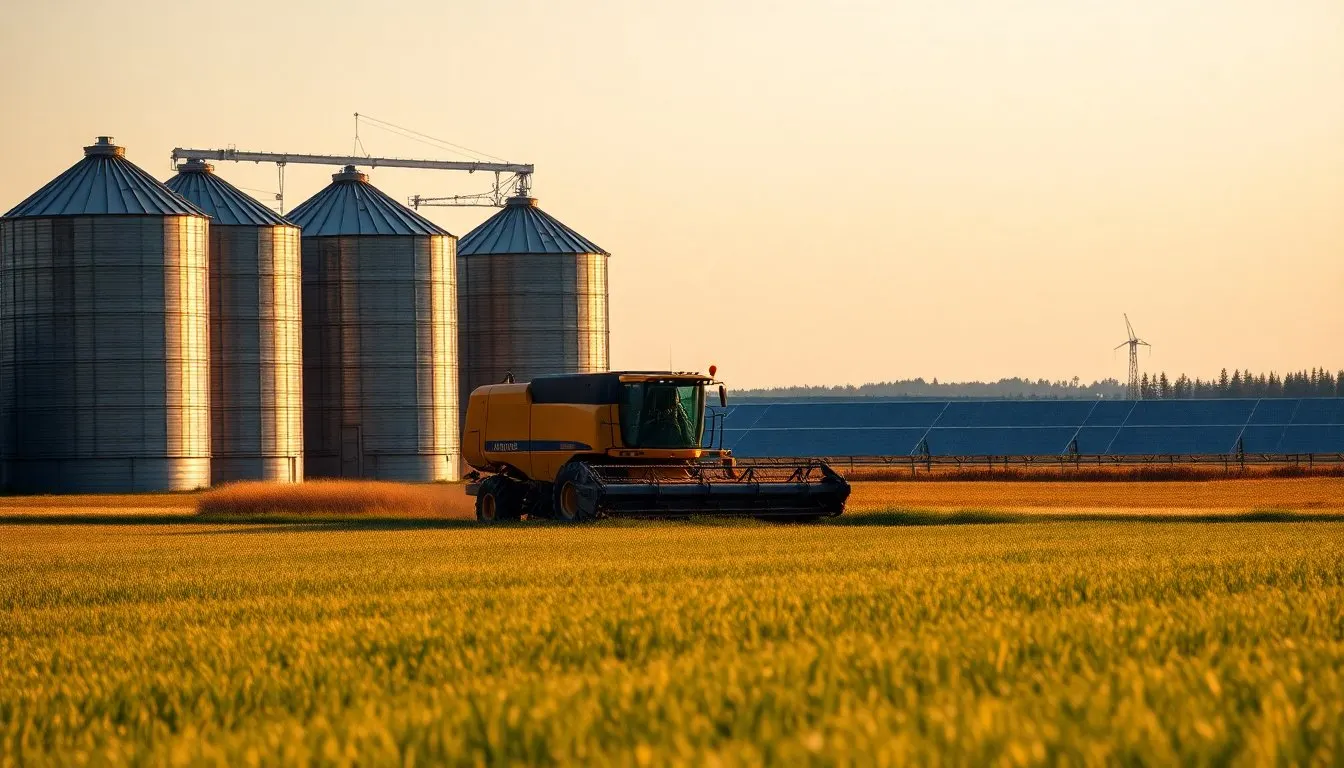
Solar can suit an arable farm, but the farm’s electricity use is lumpy. Most of it lands in a few busy weeks, at harvest and in dry spells, rather than spread evenly through the year. That changes how you size the array, whether a battery earns its keep, and how much grid connection you need. Below is how to work it out without guessing.
Two things first. Many grain dryers burn oil or gas, so they will not run on solar at all. And a system sized to the busy weeks may sit mostly idle for the rest of the year. Both are easy to miss.
What does the load look like on an arable farm?
Livestock units use power all year. A poultry house or dairy parlour has a steady base load that solar can serve every day. Our posts on poultry farms and dairy farms cover those.
Arable is different. Typical big uses are:
- grain drying and cooling after harvest
- fans and augers moving grain in store
- irrigation pumps on crops such as potatoes or vegetables
- cold stores for produce, if you have them
- workshops, offices and the farmhouse, all small by comparison
Most of these are seasonal. The question is how much of each is electric, and when it happens. A single year of half-hourly meter data answers it. Your supplier or network operator can usually provide it, and a month of summer readings is worth more than any rule of thumb.
Will solar power my grain dryer?
Only if the dryer is electric. The Agriculture and Horticulture Development Board (AHDB) describes two main approaches to in-store drying:
- High-temperature drying heats the air to at least 40°C, normally with oil or gas burners. It is fast and does not depend on the weather.
- Near-ambient drying uses fans to push air that is at most 5°C warmer than the grain through the store. AHDB gives a recommended airflow of 180 cubic metres an hour per tonne, and says drying typically takes about ten days.
AHDB also notes that in cereal production, heat is the largest energy use among fixed equipment for drying, cooling and storage. So a burner-based dryer’s main energy is fuel, and panels do nothing for it. Solar helps most with the fans, augers and conveyors around it, and with a near-ambient system whose main load is fans.
An illustrative example
This is a worked example with assumed figures, not a quote. Take a store of 500 tonnes of grain. At AHDB’s airflow of 180 cubic metres an hour per tonne, the fans move 90,000 cubic metres an hour. Assume the fan set draws 0.3kW for each 1,000 cubic metres an hour. That is an assumption, so use your own fan data. The fans then draw 27kW. Run for ten days, that is 27kW × 240 hours, or 6,480kWh.
Two points follow. The fans run day and night, so panels cover only the daylight part, and a battery or the grid covers the rest. And the demand is short and sharp. A system sized for this one job would then have little to do in winter.
Does irrigation fit with solar?
Often, yes, because pumps tend to run on sunny days when crops are thirsty. That overlaps well with solar output. But pump size matters. Large pumps can draw a lot of power at start-up, and rural networks can be weak. A pump on a long single-phase line may need a network upgrade before solar helps. Ask your electrician about the pump’s start-up load.
Water source and licence limits are a separate question that a solar project does not change.
Should you size to the peak or the average?
Size to the average, and use other tools for the peak, because a system cut to match harvest week would be far too big for the other fifty weeks, and that extra output is worth less if it is exported. Under the Smart Export Guarantee, suppliers set their own rates, and Ofgem lets installations of up to 5MW take part. Compare the offers before you assume a high price. Our guide to the Smart Export Guarantee explains how it works.
A sensible approach is to:
- gather a full year of half-hourly data
- find the base load that runs most of the year
- size the array to that base load plus the daytime peaks you can serve
- treat the harvest peak as a bonus, not the target
Does a battery help?
A battery can move solar energy from the afternoon to the evening, which suits overnight drying fans. It will not cover a dryer burner. It also adds cost, so test it on the numbers. Our guide on battery storage sets out the questions, and the answer for an arable farm often turns on how many hours of night load you really have.
What about the grid connection?
Large seasonal loads can strain a rural supply. Adding generation brings its own limits. Anything above 16 amps per phase in total needs a G99 application, and rural networks can be slow to process them. Our posts on rural grid connections and G99 explained cover the steps. Apply early, because harvest does not wait for the network operator.
Roof or field?
Grain stores and sheds often have large, strong roofs, but older sheds may have asbestos or weak purlins. Our guide on roof surveys explains the checks. A ground array takes land out of crops, which is a separate decision. Our post comparing ground-mount and rooftop systems sets out the trade-offs.
Where we can help
We are independent advisers and do not sell equipment. Our energy and ROI modelling service takes your half-hourly data and tests different array sizes, with and without a battery, so you can see where the money is made. Our agriculture and land sector page explains how we work with farms.
Sources: AHDB, in-store grain drying; Ofgem, Smart Export Guarantee; Energy Networks Association, connecting generation.
Since arable load is seasonal, size the array on a full year of data. Our energy and ROI modelling tests that, while a feasibility study checks the store roofs and the rural grid. PPA and financing advice compares owning with leasing land to a developer, and portfolio optimisation ranks sites on a farm with several yards.