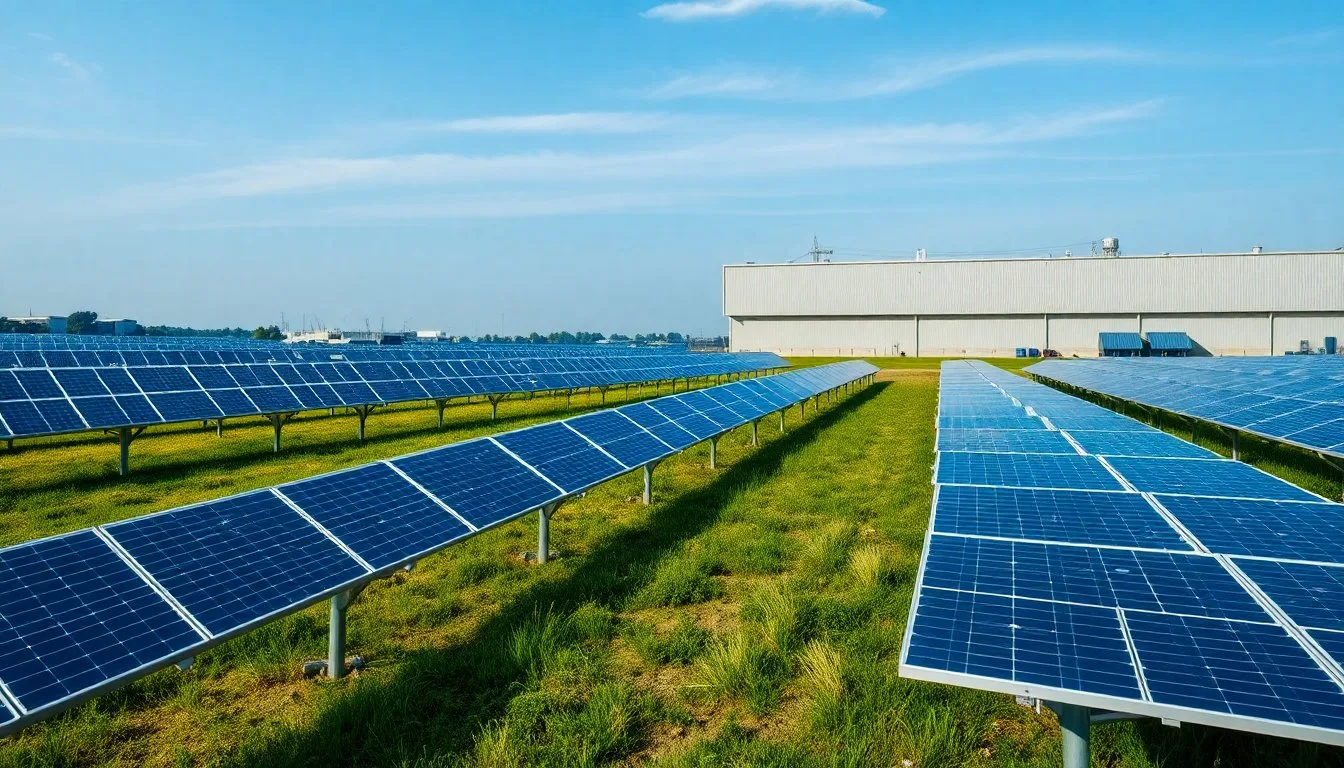
Choose rooftop solar if the roof is sound, strong enough and big enough. Choose a car park canopy if the roof fails one of those tests but you have a large car park. Choose ground-mount only if you have spare land of low agricultural value and a planning route that works. In England the planning rules differ sharply between the three, and that often decides the question before cost does.
When the roof decides it
Putting panels on the roof is the usual starting point because it needs no extra land. Four things can rule it out.
- Structure. The roof must carry the extra permanent load plus wind and snow. Check the actual condition of purlins, trusses and fixings today, not the capacity shown on drawings from the year the building went up. Our guide to roof surveys, structural loading and asbestos explains what a survey covers.
- Remaining roof life. Fitting panels to a covering that needs replacing within a few years is poor value. Replacing the roof first, or at the same time, is often cheaper than doing the jobs twice.
- Asbestos. Older industrial roofs can have asbestos cement sheets. Under regulation 4 of the Control of Asbestos Regulations 2012, whoever has repair or maintenance responsibility for non-domestic premises must manage the risk. Sheets of this kind are fragile, so they change how and whether you can fix to them. Get the register checked before design starts.
- Usable area. Rooflights, plant, ducting and shading from neighbouring buildings cut the area you can really use.
Planning: the rules are different for each option
Planning is where the three options part ways. These notes cover England only, because Scotland, Wales and Northern Ireland have their own rules, and your council may add conditions.
Rooftop. Solar on a non-domestic roof can be permitted development under Class J of the General Permitted Development Order. The roof-mounted PV route needs a prior approval application, in which the council looks at design and appearance, especially glare for neighbours. If the council does not respond within 56 days, work can start. Panels cannot protrude more than 0.2 metres from a pitched roof slope, and on a flat roof they cannot rise more than 1 metre. Listed buildings are excluded. The old 1 MW cap was removed in December 2023, subject to prior approval.
Car park canopy. Solar canopies over lawful off-street parking are covered by a separate permitted development right. The canopy cannot exceed 4 metres in height or sit within 10 metres of a home, and the council must be asked about prior approval first. Details are in the Planning Portal’s canopy guidance. Our article on solar carports and canopies covers cost and EV charging.
Ground-mount. The stand-alone solar right in Class K is tiny. It allows one unit in the curtilage, no more than 9 square metres of panel area, and nothing within 5 metres of the boundary. A commercial array is far beyond that, so expect to apply for full planning permission.
Land quality is part of the test
For a ground-mount scheme on greenfield land, the council will ask what the land is worth to farming. Government planning guidance says large solar farms should favour previously developed and non-agricultural land, and asks whether poorer quality land has been used in preference to higher quality land.
Land is graded 1 to 5 under the Agricultural Land Classification. The government’s guide says best and most versatile land covers grades 1, 2 and 3a. Grade 3b is not in that group. The grade belongs to the land, not the owner, so a paddock beside a business park is judged the same way as one deep in the country. If your spare land has no recent survey, you may need a new field survey. Our post on agricultural land classification and solar leases goes deeper.
The grid connection applies to all three
Any option above the G98 limit needs a DNO application under G99, whether the panels sit on a roof, a canopy or a field. Our G99 guide explains the steps. Ground-mount schemes tend to be larger and so can meet a harder assessment, but size is only part of it. Local headroom matters more.
Side by side
| Rooftop | Car park canopy | Ground-mount | |
|---|---|---|---|
| Main limit | Roof strength, age, covering | Size and layout of car park | Land grade, planning, space |
| England planning route | Permitted development with prior approval (Class J) | Permitted development with prior approval | Full planning permission in most cases |
| Extra benefit | No new land needed | Shaded parking, easy EV charging | Free choice of tilt and direction |
| Main risk | Hidden roof defects | Height, glare, drainage conditions | Refusal or long planning delay |
We have left out cost per kilowatt on purpose, because no official source gives a reliable commercial comparison, and quotes vary with the site. Ask each bidder to price all the options on your site against the same specification.
Could you lease the land instead?
If the land is good farmland, awkwardly shaped, or simply not worth developing yourself, a lease to a developer may beat building your own array. Our comparison of land lease vs on-site solar sets out the trade-offs. For a typical industrial site where the roof works, rooftop solar will often win on simplicity. See solar for warehouses and logistics for how that plays out.
Getting the order right
The costly mistake is picking the option before the facts are in. A feasibility study checks the roof structure, the land and planning position and the grid answer in parallel, then recommends rooftop, canopy, ground-mount or a mix. If you want costs next, our commercial solar cost pages show how price changes with system size.
Whichever option leads, test it on your own site. A feasibility study compares roof, canopy and land. Energy and ROI modelling puts the cost and yield of each option side by side, while PPA and financing advice covers leasing land to a developer. Procurement and tender support then gets like-for-like quotes for the option you pick.