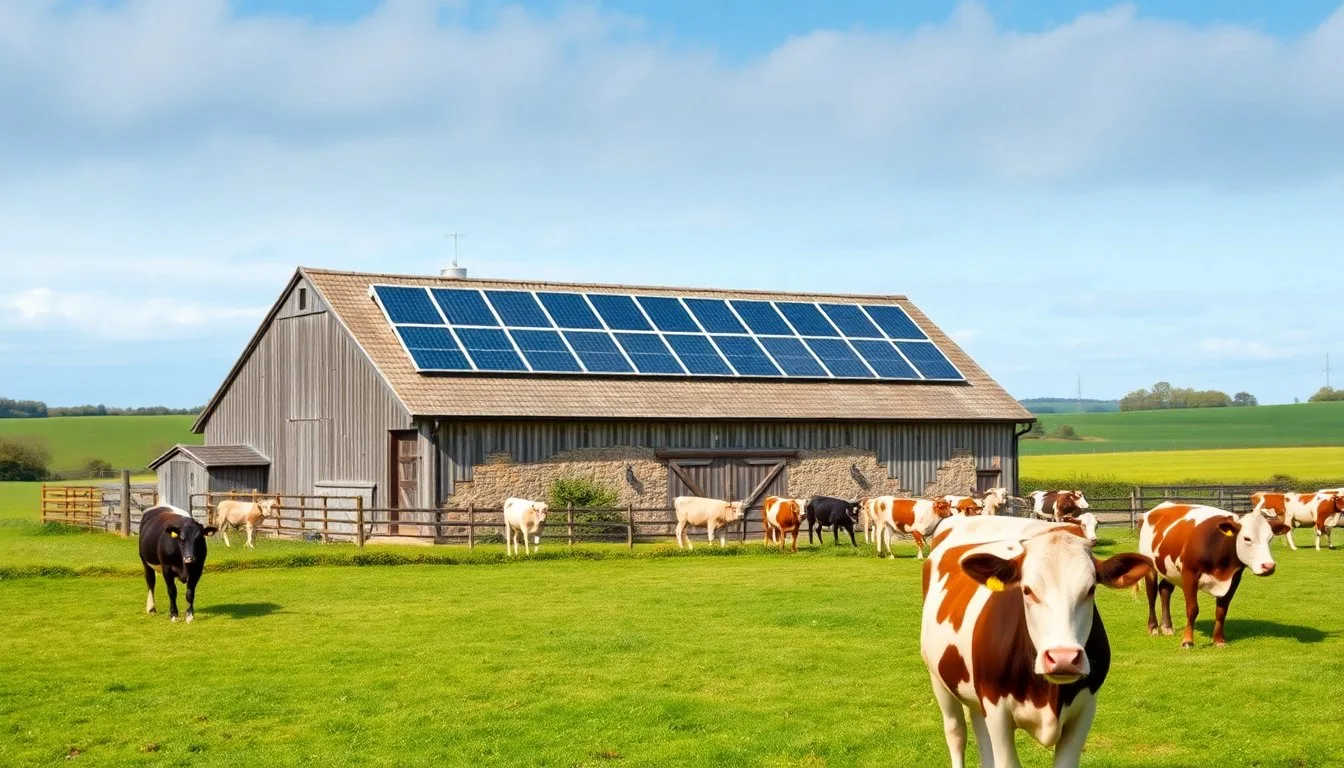
For most dairy farms the best place to start is the shed roof, because it cuts your own power bill. It also takes no land out of production. A ground-mounted array suits farms with a large, steady daytime load and spare land. A land lease suits owners who want rent, not a power asset. The right choice depends on your electricity use, your roofs and the grid capacity available.
This guide compares the three options for a working dairy unit, since each suits a different farm.
Your milking load only partly fits the sun
Solar pays best when you use the power as it is made. Dairy use is mixed, because the load changes across the day. The farming body AHDB names milk cooling, water heating and vacuum pumping as the most energy-intensive jobs on a dairy farm. They behave differently across the day.
- Milk cooling runs around the clock to hold milk at temperature. Some of that load falls in daylight, so it matches solar well.
- Vacuum and milk pumps run during milking. If a milking round falls in daylight, they use solar power directly. If it falls before sunrise or after dusk, they do not.
- Water heating for washing down is flexible. It is often the easiest load to move into the middle of the day.
So a well-sized array usually covers a good part of your use, but not all of it. An early or late milking round will still draw from the grid unless you add storage. Our guide on whether battery storage is worth it explains when that extra cost pays.
The only way to know your own split is to model your half-hourly meter data. A generic livestock average will mislead you, since every unit milks at different times.
Is the roof ready?
Large sheds often look ideal: wide, open and rarely shaded. Yet two checks come before any plan.
Roof material. Many older farm buildings have asbestos cement sheeting. The Health and Safety Executive explains that the duty to manage asbestos applies to non-domestic premises, and the dutyholder must assess whether asbestos is present and keep a written plan. Fixing panels to sheeting means drilling or disturbing it, so installers usually want it surveyed first. Often the answer is a combined re-roof and solar job carried out by a competent contractor. Our guide to roof surveys, structural loading and asbestos goes into detail.
Structure. Roof frames built for sheeting may not take the extra weight of panels and the wind loads they add. A structural check comes before any firm price. MCS, the certification body, says its MIS 3002 standard covers solar PV up to 50kWp. Larger arrays sit outside that standard, so the engineering and sign-off need extra care.
Get both right and a shed roof is usually the cheapest, least disruptive start. However, getting either wrong is the main reason a promising roof is dropped.
The three routes side by side
| Rooftop for your own use | Ground-mount for your own use | Land lease to a developer | |
|---|---|---|---|
| Who pays for the equipment | The farm | The farm | The developer |
| Return | Power you no longer buy, plus export income | Power you no longer buy, plus export income | Fixed rent set in the lease |
| Effect on farmland | None | Takes land out of farm use | Takes land out of your own use, unless grazing continues |
| Grid issue | Sized to your load, so usually modest | Export capacity matters more | The developer’s problem to solve |
| Risk | Held by the farm | Held by the farm | Mostly held by the developer |
The first two routes keep both the upside and the risk inside the business. A lease passes the building risk to someone else, while you take a rent.
Grazing under panels
Where a lease is on the table, grazing can keep the land working, although it suits some stock better than others. The government’s UK Solar Roadmap says many solar projects are designed to allow continued livestock grazing. Its worked example is a flock of sheep. A milking herd that walks to the parlour twice a day fits less easily with a fixed array, so sheep or young stock are likelier grazers. If the land is part of your own grazing rotation, a lease costs you stocking capacity. Count that cost against the rent. Our guide to agrivoltaics explains the grazing model.
Grid capacity can decide it
Any array above the smallest sizes needs permission from your network operator to connect, so grid capacity can decide the whole plan. For larger systems that means a G99 application and a technical assessment before an offer arrives. In rural areas, spare capacity can be tight, so ask early. Our articles on G99 grid connection and rural grid connections for farms set out what to expect. The South West England region page covers the area where dairy and livestock farming dominate.
Tax and ownership
Owning an array and leasing land are taxed differently, since one is an asset and the other is rent. Owning means you hold an asset and may claim allowances. Leasing means rent income, and it can change how the land is treated for other tax purposes. Rules on farmland change often, so take advice from your own accountant before signing. Our piece on lease income as property or trading income is a starting point.
A sensible order of work
- Check the roofs for material, strength and orientation.
- Model your milking and cooling load against a real array size.
- Ask the network operator about capacity.
- Compare any lease offer with what the land is worth to your herd.
Doing it the other way round is risky. A farm that signs a lease before costing the roof may find the choice looks good on paper but fails on comparison. Our land lease versus on-site solar guide sets out that trade-off. A feasibility study or energy and ROI model tests it with your own numbers. The agriculture and land sector page has wider context.
Because a dairy farm can take more than one route, compare them side by side. A feasibility study checks the sheds and the grid, and energy and ROI modelling sets milking-load savings against lease rent. PPA and financing advice covers funded options, while portfolio optimisation helps on a farm with several holdings. For a different round-the-clock load, see our guide to solar on poultry farms.