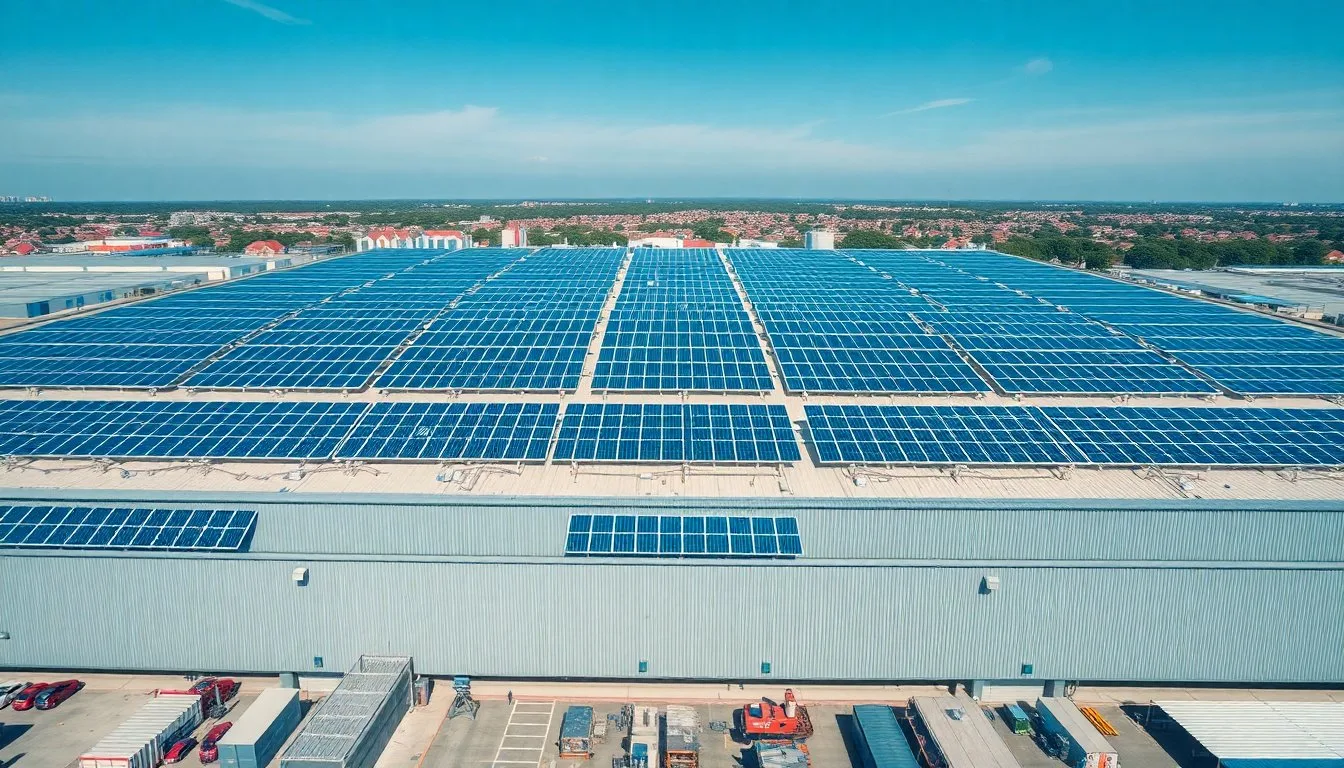
The most reliable official figures cover systems up to 50 kW. In 2025/26 the average installed cost of a non-domestic system of 10 to 50 kW was about £1,170 per kW, according to government data. Above 50 kW there is no official price series, so any single “price per kW” you see for a large system is a market estimate. Cost per kW does fall as systems get bigger, and the only sound way to price your own project is to get comparable quotes against one specification.
What the government data shows
The Department for Energy Security and Net Zero (DESNZ) publishes small-scale solar PV cost data taken from the MCS installation database. The 2025/26 release covers installations up to 50 kW. It includes the cost of equipment, installation and connection, plus VAT where it applied. It leaves out batteries.
For non-domestic installations in 2025/26, the mean cost fell as size went up:
| System size | Mean cost, non-domestic, 2025/26 |
|---|---|
| 0 to 4 kW | £1,650 per kW |
| 4 to 10 kW | £1,320 per kW |
| 10 to 50 kW | £1,167 per kW |
DESNZ’s own commentary says the average cost per kW is lower for larger installations, and that median costs in the 10 to 50 kW band were about a quarter lower than for 0 to 4 kW systems.
Two cautions still apply. These figures stop at 50 kW, and the data comes from MCS-registered installs. Systems of 100 kW and above have no equivalent public series, so be wary of any table that claims precise prices for them.
Why bigger usually means cheaper per kW
Some costs do not rise in step with panel count. Design, project management, the DNO application, scaffolding set-up and commissioning are largely fixed. Spread over more panels, they shrink per kW. That is the pattern in the DESNZ figures, and it is why a 400 kW roof should not be priced by scaling up a 40 kW quote.
What moves the price on your site
- The roof. A sound, simple roof is the cheapest case. Reinforcement, a replacement covering or asbestos handling all add cost. See roof surveys, structural loading and asbestos.
- The grid connection. A site with spare local capacity pays for a simple connection. A site that needs network works pays more, and the DNO sets that charge. Our G99 guide explains the process.
- Mounting type. Ground-mount and canopy structures cost more to build than roof fixings. Compare them in ground-mount vs rooftop solar.
- Batteries. Storage is a separate cost with a separate payback. See whether commercial battery storage is worth it.
- VAT. Our note on VAT on commercial solar explains how it applies to a business buyer.
A worked example, with the assumptions shown
This is an illustration, not a quote, because every input is an assumption that you should replace with your own figure.
Assumptions
- System size: 100 kWp.
- Installed cost: £100,000 (£1,000 per kWp, a round figure a little below the DESNZ 10 to 50 kW average, since larger systems tend to cost less per kW).
- Annual output: 900 kWh per kWp, so 90,000 kWh a year.
- Share used on site: 70%, so 63,000 kWh.
- Value of power used on site: 25p per kWh in the first case, 20p in the second.
- Value of exported power: 5p per kWh on 27,000 kWh.
- Operating costs, panel ageing and tax relief ignored.
| Case 1: 25p power | Case 2: 20p power | |
|---|---|---|
| Saving on power used on site | £15,750 | £12,600 |
| Income from export | £1,350 | £1,350 |
| Annual benefit | £17,100 | £13,950 |
| Simple payback | 5.8 years | 7.2 years |
A drop of five pence in the price you avoid adds more than a year to payback. That is why the quote you accept should come with your own half-hourly usage and your own tariff, not a generic assumption. A business that uses more of its output on site does better than one that exports it. Export income depends on the supplier under the Smart Export Guarantee, which Ofgem says covers systems up to 5 MW.
Tax relief changes the real payback
The example above ignores tax, and that matters. Solar counts as special rate spending, not main rate, so full expensing does not apply. Relief usually comes through the Annual Investment Allowance, which is £1 million a year. Spending above it, or an allowance already used elsewhere, slows the relief. Our post on corporation tax and solar cash flow shows how this feeds the cash flow.
The MCS point
MCS standard MIS 3002 covers systems up to 50 kWp. Anything larger should be specified, warranted and commissioned as a full commercial project, with performance and defects terms written into the contract.
How to get a number you can trust
- Commission a feasibility study so roof, grid and yield are known before anyone quotes.
- Write one specification and send it to several bidders. Our procurement and tender support does this.
- Model the result on your own usage and tax position with energy and ROI modelling.
Our commercial solar cost pages walk through the cost drivers by system size, and the 250 kW page is a good place to start for a mid-sized roof.
Cost is only half of the answer, because payback depends on self-use and tax. Our energy and ROI modelling uses your own meter data, and a feasibility study confirms the site first. Procurement and tender support gets comparable quotes, while PPA and financing advice shows the cost of not paying upfront.