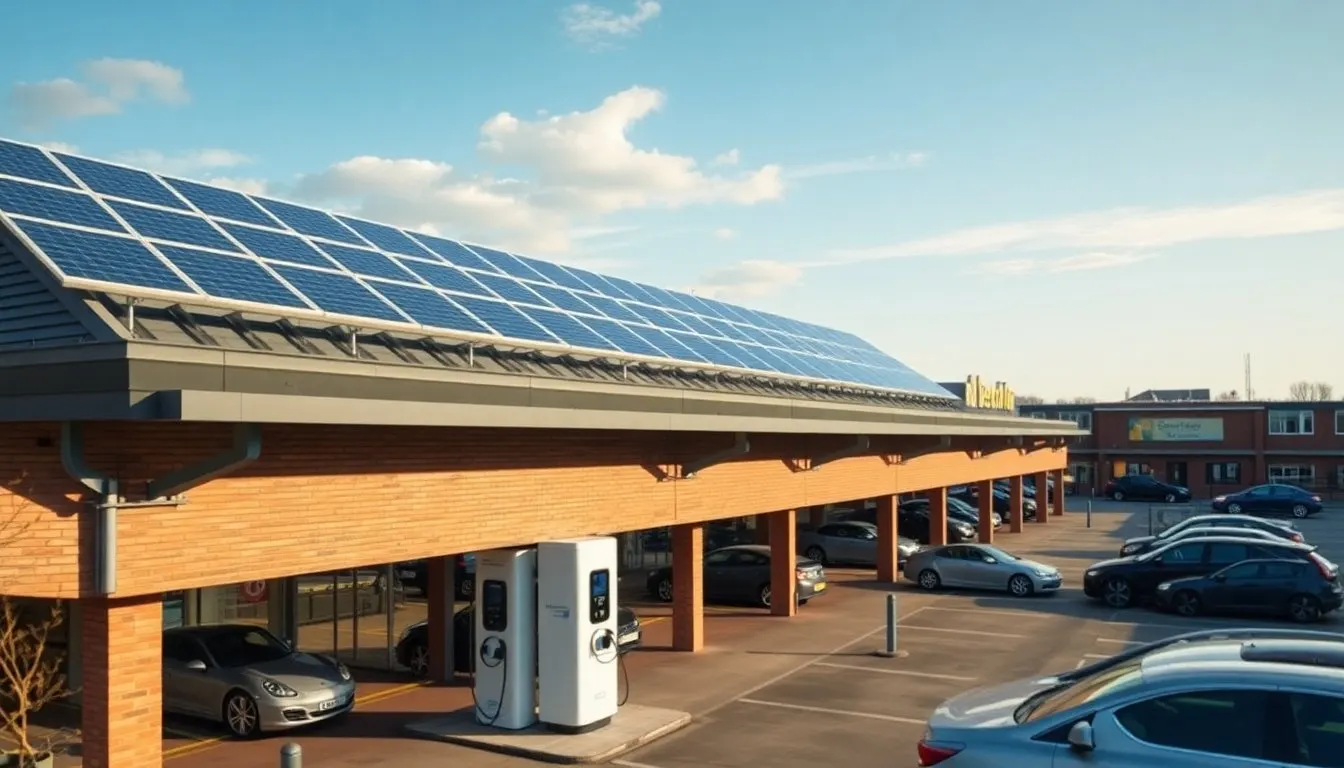
Retail parks and shopping centres can be good sites for solar. Shops use power when the sun is up, and the roofs and car parks are large. The hard part is usually not the engineering. It is the lease. The landlord owns the roof, the tenants use most of the power, and someone has to agree who pays and who gains. Settle that early, and the technical case often follows.
This guide covers load, canopies and EV charging, ownership models, business rates and energy-efficiency rules. It is general guidance for England unless we say otherwise, so check the details against your own leases.
Does the load match?
In general, a shop’s lighting, air handling, refrigeration cases and escalators run hardest while the doors are open. Opening hours overlap with daylight for much of the year, so a good share of what a roof array makes is used on site. Power used on site avoids the price you would have paid. Power exported earns the lower export rate, which our guide to the Smart Export Guarantee explains.
That is a general pattern, not a promise. Late-opening units, evening leisure tenants and plant that runs overnight all change it. The test is half-hourly meter data for the landlord’s supply and, where you can get it, for the tenants’ meters.
Who holds the meters matters. In many multi-let schemes the tenants buy power on their own contracts, and the landlord’s supply covers only the common parts. If so, power from the roof has to be sold or supplied to the tenants, or the system will mainly serve the landlord’s smaller load.
Roof, canopy or both?
Roofs are cheaper per kilowatt, if they can carry the load. Our guide to roof surveys before solar explains what to check. Car-park canopies cost more because you are building steelwork as well. Our guide to solar carports and canopies covers costs, the planning route in England and how vehicle height limits the design.
For many retail sites the best answer is both. Use the roofs that pass a structural survey, then add canopy over the bays where a roof cannot help or where EV charging is wanted. Compare the options in a feasibility study before specifying anything.
EV charging
Canopies and charging suit each other. The steel that shades the bays can carry the equipment and cables, so civil works are shared. Three points apply to retail sites.
New buildings. Approved Document S requires, for new non-residential buildings with more than 10 parking spaces, one charge point and cable routes for at least one in five of the remaining spaces. It does not by itself apply to a canopy added to an existing car park.
Public charge points. The Public Charge Point Regulations 2023 cover charge points accessible to the public, including free ones. They require contactless payment on new points of 8kW and above, and a free 24/7 helpline. Rapid points of 50kW and above must be reliable 99% of the time on average over a year. Whether your chargers count as public depends on access. Ask for a legal view, because retail car parks vary.
Grants. The Workplace Charging Scheme is aimed at staff and fleet charging, and its rules limit who may use business chargers, as we explain in the canopy guide. Public chargers for shoppers are a different case, so do not assume the grant applies.
Charging adds load to the car park supply. Work out your demand early, because a busy bank of chargers can change the grid connection you need.
Who pays? The landlord and tenant problem
In a multi-let scheme, the landlord owns the roof and car park and would normally pay for the system. Tenants use most of the daytime power. So the party that pays is not the party that saves. That is the split-incentive problem, and three routes are commonly compared:
- Recover the cost through the service charge, where the lease allows it. Read the wording on improvements and capital items closely.
- The landlord keeps the system and sells power to tenants at an agreed price. This needs metering, billing and a supply arrangement that tenants accept.
- A third party funds the system under an on-site power purchase agreement, and the landlord carries no capital cost. Our guide to PPA, purchase and lease options compares the models.
Which suits you depends on lease terms, how long each tenant has left and the landlord’s appetite for risk. Settle the approach before you commission technical work, because it changes what “viable” means. Our case studies show worked examples of multi-let schemes, built on stated assumptions.
Business rates
Installing solar should not raise the rates bill on the building. The Government’s regulations, SI 2022/405, exempt plant and machinery used for renewable generation and storage in England from 1 April 2022 to 31 March 2035. The Valuation Office Agency administers it. The explanatory memorandum is England-only. Wales consulted on its own approach, so do not assume an equivalent rule there. Check the current VOA guidance for your property before you rely on it.
EPC ratings and lettability
The Minimum Energy Efficiency Standards (MEES) already make it unlawful to let a non-domestic property rated below EPC E, unless an exemption is registered. In June 2026 the Government published an interim response proposing EPC B from 2031 for privately rented non-domestic buildings over 1,000 square metres, where cost-effective. Jones Day’s summary notes that this is not final law until Parliament passes the regulations. The earlier EPC C step for 2027 has been dropped.
If a unit is close to a threshold, solar may help its rating. How much depends on the building. Our guide to EPCs, MEES and solar explains what to expect.
What payback to expect
We will not quote a standard payback here, because retail roofs vary so much in size, orientation and load. Payback depends on the roof area, the share of power used on site, whether canopy is included and how the scheme is funded. A PPA gives up some of the return in exchange for no capital outlay and no generation risk. Our cost and payback pages give bands by system size. If you run shops across many sites, our note on sequencing a multi-site retail rollout covers ranking and order.
First steps
Gather four things: the lease terms, the meter data, a roof survey and a view on car-park use. Then commission a feasibility study that covers roofs, canopies, charging and grid headroom together. Our feasibility studies give a clear go or no-go and a specification precise enough to tender against. For the wider picture on let property, see our page on commercial and office property.
Because tenants hold the meters, the funding route matters as much as the roof. Our PPA and financing advice compares landlord, tenant and PPA models, while energy and ROI modelling prices each. A feasibility study checks the roofs and car parks, and portfolio optimisation ranks sites across an estate. Chains should also read sequencing a multi-site rollout.