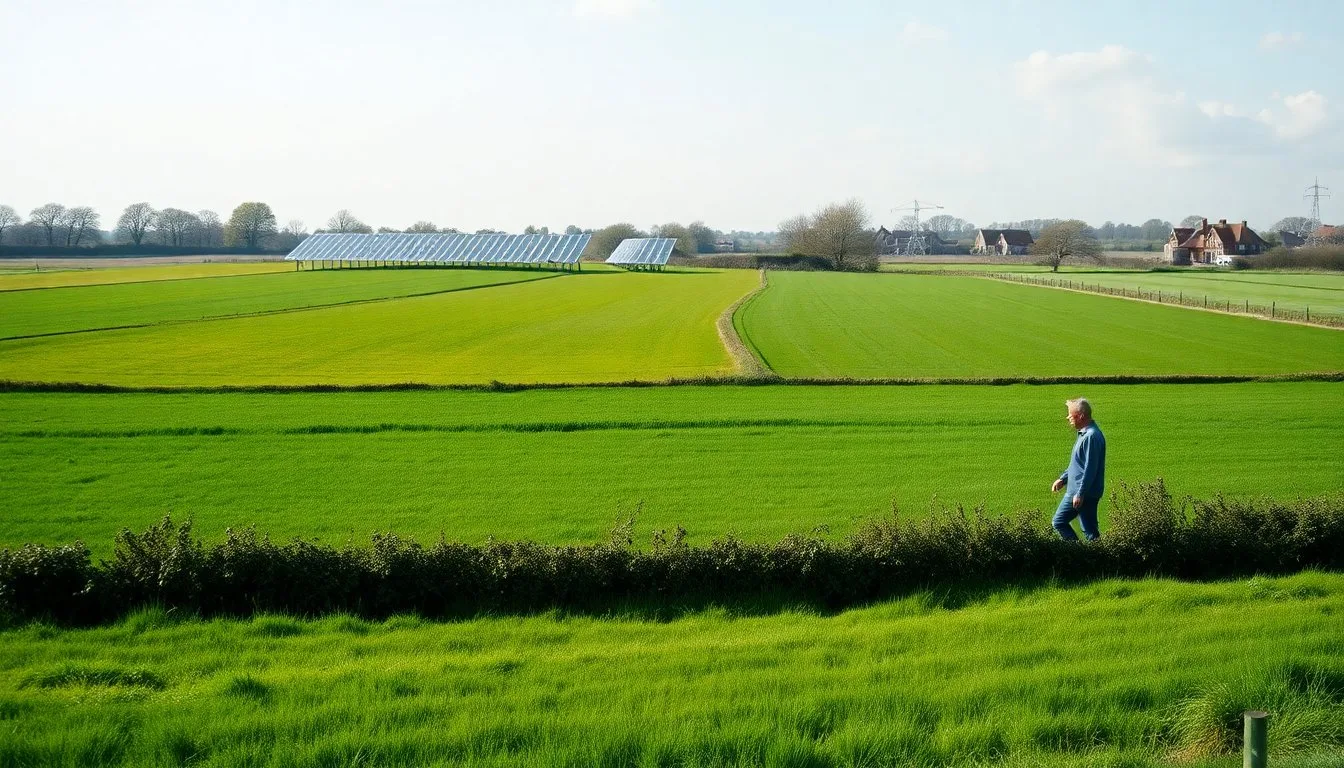
The Agricultural Land Classification (ALC) grade of your field strongly affects whether a ground-mounted solar scheme gets planning permission. Land graded 1, 2 or 3a counts as “best and most versatile” (BMV). Planning policy says to use poorer land where possible. So a developer who offers you a lease on BMV land carries more planning risk, and your terms should reflect that.
Developers rarely lead with this. The rent and the term come first, because the grade is often left to “survey stage”. Ask about it early.
How the grades work
ALC places farmland in five grades. While the system is simple, the planning effect is large. The government’s guide to assessing development proposals on agricultural land describes them like this:
| Grade | What the guide says | BMV? |
|---|---|---|
| 1 | No or very minor limitations | Yes |
| 2 | Minor limitations that affect yield, cultivation or harvest | Yes |
| 3a | Moderate to high yields of a narrow range of arable crops | Yes |
| 3b | Moderate yields of a narrow range of crops | No |
| 4 | Severe limitations that restrict the range of crops or yield | No |
| 5 | Very severe limitations; use restricted to permanent pasture or rough grazing | No |
The same guide states that BMV land is graded 1 to 3a. The planning framework’s glossary agrees. It adds that grading rests on yield, range of use, versatility and need for input.
Grade 3 is the awkward one. Although it looks like a single grade, a map that says “grade 3” tells you little until someone splits it into 3a or 3b. That split decides whether the land counts as BMV.
What planning policy says now
You may have read that the government banned solar on the best farmland. The position is less blunt, yet it has changed.
In May 2024 a written ministerial statement set tougher expectations on solar and BMV land. The August 2026 edition of the National Planning Policy Framework lists that statement as incorporated or no longer up to date. The rule now sits in the framework itself.
Two parts matter most:
- Policy N2, point 1(b) asks development proposals to take account of the quality of agricultural land, including BMV land and its grade. If significant development of agricultural land is necessary, they should use poorer land where possible.
- Policy N1 tells plan-makers to steer development away from higher-quality agricultural land where poorer land is available.
Neither says “never”. They set a strong preference, and a scheme on BMV land has to justify itself against it. Because of that, councils and developers treat better land as the harder case.
The government’s Land Use Framework for England, last updated in May 2026, takes a wider view. It commits to safeguarding the best farmland from permanent change of use. It also describes farming continuing alongside solar, such as grazing under panels. Even so, it says the choice of how to use land is still for landowners to make.
Why a survey grade can differ from a map
Screening maps are only a guide. The government guide says a new detailed survey may be necessary where no site survey report exists. A proper survey looks at soil, climate and site conditions on your own parcel.
The guide also says when councils must consult Natural England. That applies where a proposal outside the approved development plan is likely to cause the loss of 20 hectares or more of BMV land. A big scheme on good land may well face that scrutiny.
The practical point is simple. The grade that matters is the surveyed one, because it can come back higher or lower than a desk estimate.
Where grazing helps
If sheep keep grazing between and beneath the panels, an applicant can argue that the land stays in farm use. That is a stronger case than asking a council to accept the loss of good land. Our guide to agrivoltaics in the UK explains how this works.
It only helps if the plan is real. A grazing promise added late carries little weight, while a credible one has a stocking plan and a panel layout built for livestock. It also needs a management commitment that someone can enforce.
Questions to ask before you sign
- What grade does the developer think the land is, and on what evidence? If the answer is a desk study, ask for a detailed survey before you grant exclusivity.
- What happens if the survey comes back higher? Get the fallback in writing: a shorter option period, an earlier break right, or the developer carrying the survey cost.
- Is there a grazing or cropping plan? If your land is BMV, raise it at heads of terms and ask who owns the livestock arrangement.
- How long can the developer hold you? An option can tie up land for years while planning runs. Check the end date and what you can do if consent is refused.
- Does the rent reflect the risk and the land? Our article on solar farm land lease payments looks at how rent is set. Higher planning risk is a cost for the developer, and it belongs in the negotiation.
- What does the lease do to your tax position? Rent from a solar lease can be treated differently from farming income. See property income versus trading income and take advice from your own accountant.
Lease or generate your own power?
A lease is not your only option. Some farms are better served by solar on roofs, because that cuts their own bills. Our land lease versus on-site solar guide compares the two. The agriculture and land sector page covers the wider picture. The glossary defines the terms used here.
Get an independent view first
An option letter and a planning summary are not neutral, since they come from the party who wants the deal to go ahead. An independent feasibility study can test the likely grade, grid position and planning risk before you commit to exclusivity. Then you negotiate from facts about your own land.
If a developer has approached you, a feasibility study can check the grade and the grid before you sign. Our energy and ROI modelling compares lease rent with running your own array, while PPA and financing advice covers who funds what. For several fields or farms, portfolio optimisation ranks which land to offer first.