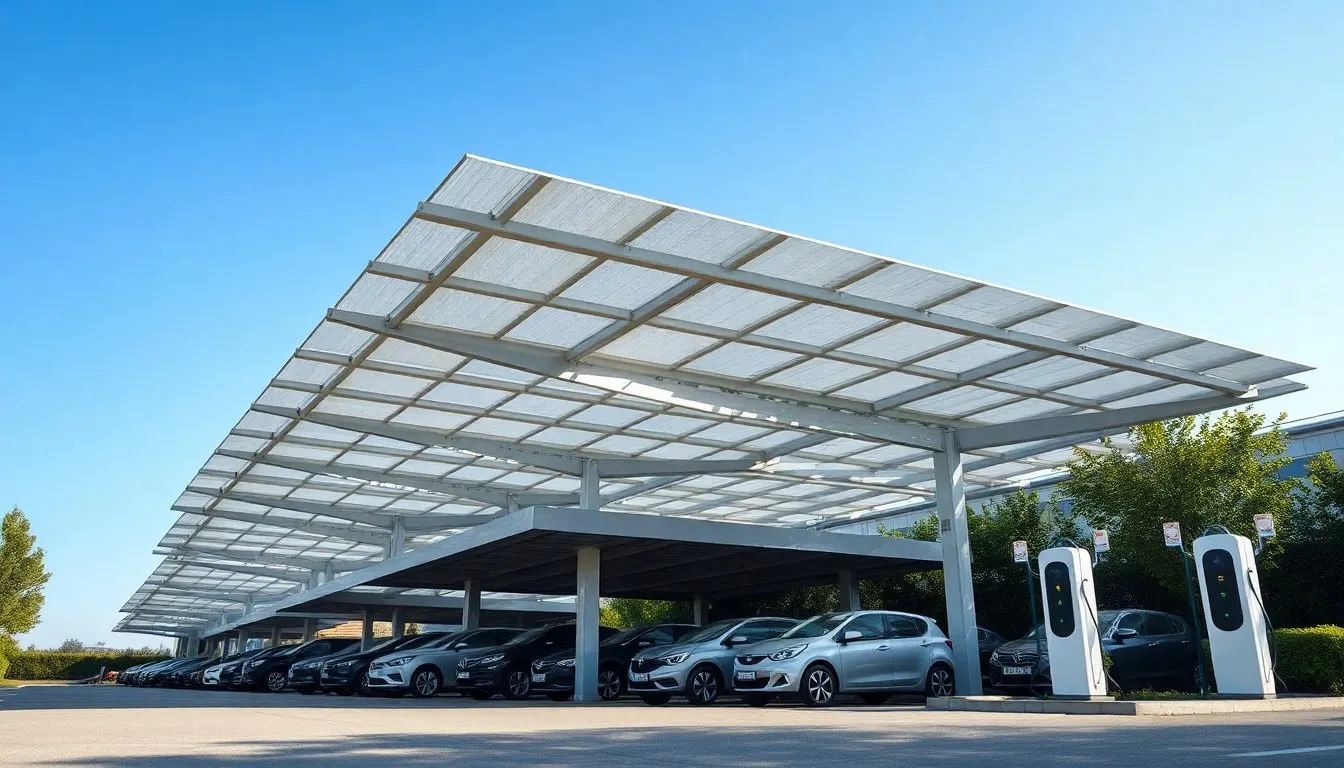
A solar canopy costs more per kilowatt than the same panels on a roof, because you are also buying a steel building with its own foundations. In England, many canopies over non-domestic car parks can use a permitted development route called Class OA, subject to prior approval from the council. That surprises people who assume a full planning application is always needed. Canopies also pair well with EV charging, and a government grant can cut the charger cost.
This guide covers cost, planning, headroom, charging and tax. Treat the cost ranges as a starting point for quotes, not a budget.
What does a solar carport cost?
We could not find an official UK benchmark, so the figures below come from installers’ guides, and they disagree. Reonic’s 2026 guide puts commercial carports at £900 to £1,400 per kWp. SurgePV’s guide gives £650 to £1,050 per kWp, and says carports typically cost two to three times as much per kWp as standard rooftop solar. Both sell into this market, so treat the numbers with care.
What the sources do agree on is the reason. The steel structure is a large share of the bill. SurgePV’s breakdown for one common design puts steel at about 45% of the cost, panels at 30%, electrical work at 15% and design and project management at 10%, before any EV charging.
That shapes the decision, because a canopy rarely wins on cost per kilowatt alone. It wins when the roof is unsuitable, there is no spare land, or you want covered parking and charging in the same project.
Cost per kilowatt also falls with scale, and it varies with span, ground conditions, wind exposure and how far the cable must run to the main intake. Get at least two quotes for the same specification. Add separate lines for chargers, any battery, and any grid reinforcement the network operator asks you to fund. Our commercial solar cost pages show rooftop bands by system size for comparison.
Do solar canopies need planning permission?
Often they need a prior approval application rather than a full planning application, in England. Class OA of the General Permitted Development Order covers installing, altering or replacing a solar canopy over lawful off-street parking that is not for a house or block of flats. Several installer guides say canopies always need full planning permission. For many sites that is out of date.
The right still has limits. It does not apply if any part of the canopy:
- is higher than 4 metres above ground level;
- is within 10 metres of the curtilage of a house or block of flats;
- sits within the curtilage of a listed building or on a scheduled monument; or
- is used to display advertisements.
You must apply to the local planning authority for prior approval first. It looks at siting, design, appearance and glare on neighbours. You need drainage that sends rainwater to a permeable area if the surface under the canopy is permeable. The canopy must be completed within three years, and removed when no longer needed. The legislation text sets no capacity limit for Class OA.
Rules differ in Scotland, Wales and Northern Ireland. If your canopy is taller than 4 metres, near homes, or at a listed site, you need a full application. Building control approval for the structure is a separate matter, whatever the planning route.
For how this compares with other mounting options, see our guide to ground-mount versus rooftop solar.
How high should the canopy be?
Height depends on what must drive underneath. Cars and vans need far less than delivery lorries, coaches or refuse vehicles. Confirm the full vehicle mix, including occasional visitors, before the structural design is fixed. Changing it afterwards is costly.
The 4-metre limit in Class OA matters here, because a canopy that must clear tall vehicles may exceed it and so lose the permitted development route. Check this at the earliest design stage.
Can a canopy and EV charging work together?
Yes, technically. The canopy structure can carry cabling and mounting for chargers, and the same trenching serves both. The canopy’s output does not directly pay for the chargers, so model them as one project with separate lines.
Two rules and one grant are worth knowing:
- Building Regulations Part S. For new non-residential buildings with more than 10 parking spaces, Approved Document S requires one charge point and cable routes for at least one in five of the remaining spaces. It applies to new buildings and major renovations, not to a canopy added over an existing car park.
- Workplace Charging Scheme. The scheme pays up to 75% of purchase and installation costs, capped at £500 per socket for installations completed on or after 1 April 2026, for up to 40 sockets per applicant across all sites. Funding is confirmed to 31 March 2027. You need a voucher before work starts, and business chargers are for staff and fleet use.
The grant is small next to the canopy cost, but it can make the charger side easier to justify. Plan charger demand too. A busy bank of chargers can raise your peak demand and affect your grid connection.
Exports, grants and tax
Exported power can earn payments under the Smart Export Guarantee, which Ofgem says covers installations up to 5MW. Our guide to the Smart Export Guarantee explains how rates compare. Commercial-scale systems connect through the G99 process, which our G99 guide covers.
On tax, HMRC’s manual says that all capital expenditure on solar panels is designated special rate. That matters because full expensing is aimed at main-rate assets. The Annual Investment Allowance is £1 million a year. Whether the supporting steel counts with the panels or separately is a question for your accountant. We cover the common mistake in our piece on solar and full expensing.
When a canopy beats the alternatives
A canopy earns its premium in three cases: the roof cannot take the load or is too small; there is no spare land but there is a large car park; or EV charging is already planned. Retail parks, distribution sites, hospitals, schools and business parks are the usual candidates. For retail sites in particular, see our note on solar for retail parks and shopping centres.
Where none of those cases applies, a roof or ground array usually wins on cost. A feasibility study makes that comparison for your site before anyone specifies steelwork.
Canopies rarely win on cost per kilowatt alone, so the case needs testing. A feasibility study checks the car park, the grid and the planning route. Energy and ROI modelling adds charging and the grant, while procurement and tender support gets steelwork and electrical quotes on one basis. PPA and financing advice covers funded canopies.