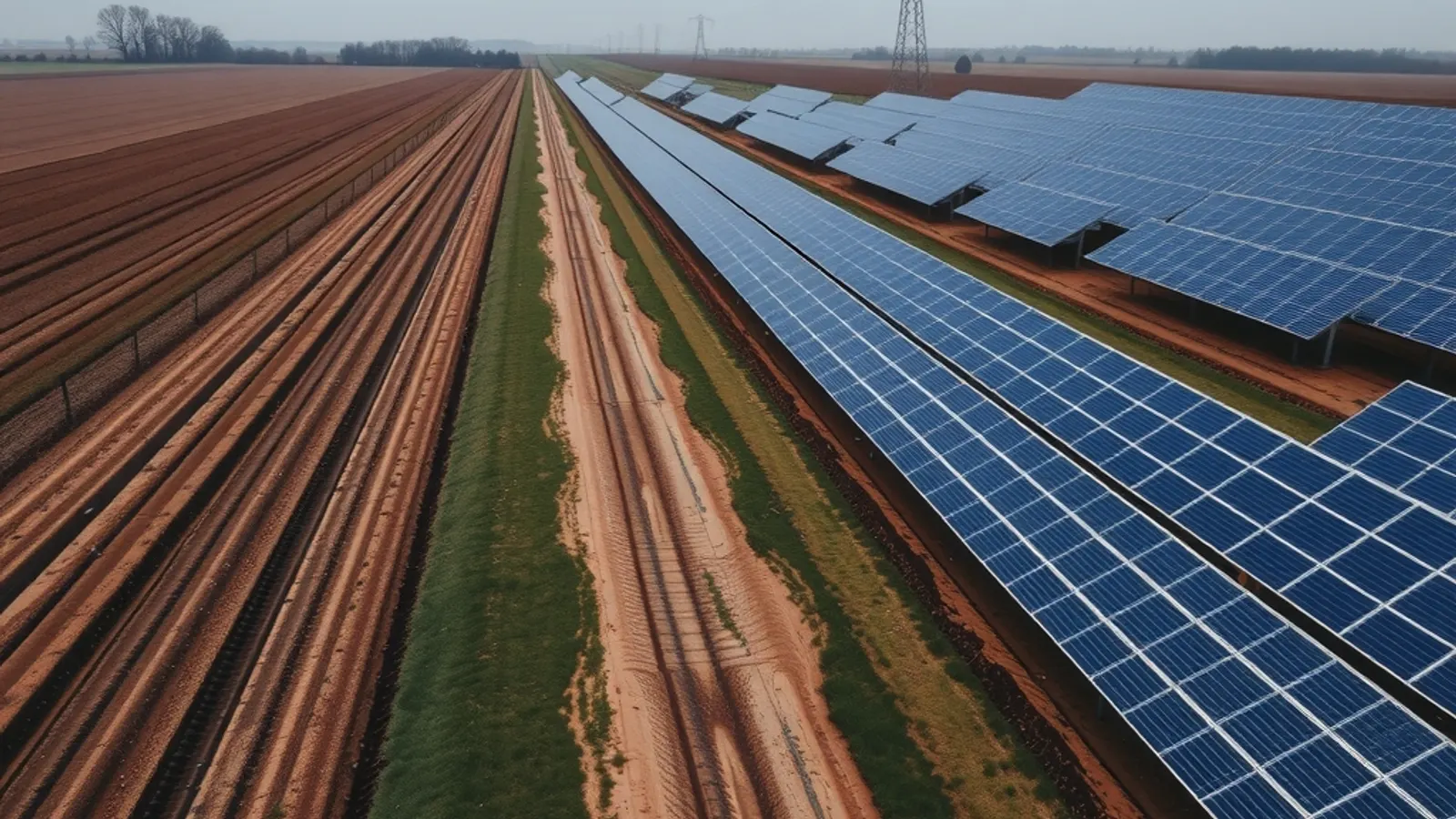
If you let a field to a solar developer, the rent is normally taxed as property income. It is not treated as profit from your farm. That is true even if you farm the next field yourself. The label sounds like a dull accounting point, but it changes four things: whether you can average the income, whether National Insurance applies, how VAT works, and, most importantly, what happens to inheritance tax relief on the rest of the holding.
This post is general information, not tax advice. Rules and rates change, and your facts matter. Take advice from a tax adviser before you sign.
Why rent counts as property income
When you grant a lease of land to a third party, you are a landlord. Income from land you let out falls under the property income rules in Part 3 of the Income Tax (Trading and Other Income) Act 2005. The developer, not you, runs the solar business. You have no trading activity in it.
There is a grey area. If a farmer builds and runs a solar plant as part of the farm business, the income may be part of that business. A passive lease to a developer is different. If your arrangement is anything other than a straight lease, get advice on how the income should be reported.
What changes in practice
| Point | Farming trade profit | Solar lease rent |
|---|---|---|
| Farmers’ averaging | Available to a qualifying farming trade | Not available |
| Class 4 National Insurance | Charged on self-employed profits | Not charged on rent |
| Losses | Can be set against other income, within rules | Generally carried forward against property income |
| Inheritance tax relief | Can qualify | Let land is an investment, so it is at risk |
Averaging. Self-employed farmers can average their taxable profits over two or five years. The rules cover profits of a qualifying farming trade. Rent from a lease is outside them, so a good solar rent year cannot be smoothed against a poor farming year.
National Insurance. Class 4 contributions apply to the profits of the self-employed. For 2026 to 2027, the rates are 6% on profits between £12,570 and £50,270, and 2% above that. Rent is not a trading profit, so no Class 4 is due on it. That is a small gain, but it is real.
The inheritance tax risk to the rest of the farm
This is where landowners get caught out.
Business relief on a farming business is not available if the business consists wholly or mainly of dealing in land or buildings or making or holding investments. Rent from a solar lease is investment income. One field let for solar next to an active farm is unlikely to tip the balance by itself. But the test looks at the whole business. A farm that slowly moves towards rent over the years can drift into the danger zone. Land let to a developer also stops being farmed, which may affect agricultural property relief on that land. HMRC’s guidance says land must be occupied for the purposes of agriculture for a minimum period to qualify.
The relief itself has changed. From 6 April 2026, a combined allowance of £2.5 million applies to property qualifying for 100% agricultural or business relief, with 50% relief above that. The page says the legislation was in Finance Bill 2025-26, so check the final position on GOV.UK. Unused allowance can pass to a surviving spouse or civil partner. A larger estate means more value sits above the limit, and then every pound of lost relief costs more.
So ask three questions before signing:
- How much of the holding will be let, as a share of total land, turnover and time spent?
- What happens to relief on the let land itself once it stops being farmed?
- What would the estate look like if relief on the let land and the wider business were reduced?
Does VAT apply to the rent?
Not by default, because granting an interest in land, which includes a lease, is an exempt supply for VAT. You do not charge VAT on the rent. You also cannot normally recover VAT on costs linked to that land.
You can still choose to charge VAT by opting to tax the land. Then rent is standard-rated and you can recover related VAT. That choice is hard to undo. You can cancel it in a six-month cooling-off period using form VAT1614C. Beyond that, you can revoke it only after 20 years using form VAT1614J, or with HMRC permission. Take advice first.
Option fees
Most solar deals start with an option agreement. The developer pays for the exclusive right to develop the site before planning permission is granted. Whether that payment is income or a capital sum can depend on how the agreement is written. Do not assume either answer. Ask your adviser to review the draft.
Schemes and payments
Because land under a solar lease is no longer farmed, the lease can affect farm support payments and environmental scheme agreements on that parcel. Our post on the Sustainable Farming Incentive and solar covers that question. For lease rates, see solar farm land lease payments in 2026. For the land classification that developers care about, see agricultural land classification and solar leases.
Worked example (illustrative only)
Assume a mixed farm of 200 acres in one name, with 20 acres let for solar. Assume farming still takes most of the owner’s time and brings in most of the income. On those assumptions, the lease looks like a modest addition. Now assume the owner lets 120 acres over five years, farms little, and rent becomes most of the income. The same tax rules now point the other way. The numbers are invented. They only show how the same law can give different answers as the mix changes.
What to do before you sign
Model the net rent after tax, not the headline figure in the developer’s letter. Model the inheritance tax position with and without the lease. Check VAT. Then compare the offer with other land uses. Our energy and ROI modelling service puts these numbers next to each other, and our agriculture and land sector page explains how we work with landowners. If you are weighing a lease against using the land yourself, see land lease versus building solar.
Sources: ITTOIA 2005, Part 3; GOV.UK, income tax averaging rules for farmers; GOV.UK, self-employed National Insurance rates; Inheritance Tax Act 1984, section 105; GOV.UK, APR and BPR changes; HMRC Inheritance Tax Manual, practice note 10; VAT1614C; VAT1614J.
Tax shapes the real value of a lease, so model it before you sign. Our energy and ROI modelling shows rent after tax beside running your own array. PPA and financing advice reviews the lease terms, while a feasibility study checks whether the land suits solar at all. For a large estate, portfolio optimisation ranks the options.