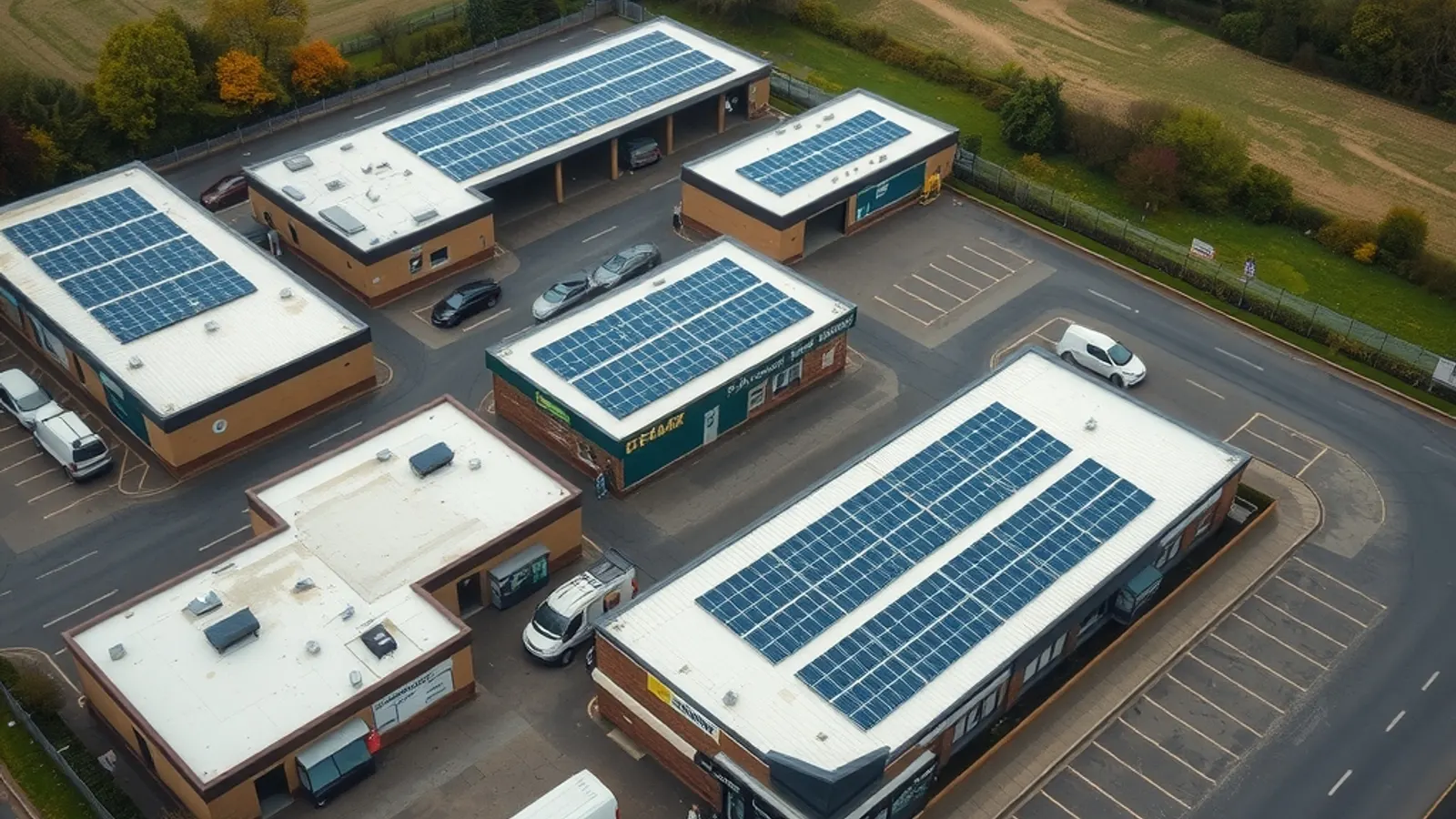
Rank every store first, then roll out in tranches. Put the stores with the best mix of daytime power use, sound roofs, spare grid capacity and long tenure in tranche one. Size each tranche to the tax relief and installer capacity you have that year. Then pull the rest forward or back as lease events, grid offers and compliance dates dictate. Doing every store at once is rarely possible, and doing them one by one as separate projects wastes the scale you hold.
Why a chain cannot do everything at once
Three limits bite before the whole estate can move.
Tax relief arrives in a yearly block. Solar counts as special rate spending, and the Annual Investment Allowance is £1 million a year. It is shared by related companies. HMRC’s manual treats companies under common control as related if they run from the same premises, or if more than half of each one’s turnover falls in the same broad activity category, so a retail group should check how its own structure shares one allowance. Spending above the allowance for a company falls to the slower special rate route we describe in why full expensing does not apply to solar.
Grid offers arrive store by store, because each store applies to its own network operator under G99. Two stores that look the same can sit on very different feeders. See our G99 guide for the steps and grid capacity in 2026 for the wider picture.
Delivery capacity is finite, because installers and scaffolders can only cover so many sites in a region at once.
Ranking the stores
Score every store on a short list of factors before you commit money anywhere.
| Factor | What to look for | Why it matters |
|---|---|---|
| Daytime power use | Long trading hours, refrigeration, heating and cooling that run when the sun is up | The share you use on site drives payback |
| Roof | Recent covering, confirmed load capacity, no asbestos | Roof defects are a common reason a store fails feasibility |
| Grid | A feeder with known spare capacity | Decides whether the connection is fast or costly |
| Tenure | Freehold, or a lease running well past payback | Avoids spending on a site you may hand back |
| Compliance exposure | Large stores, let stores, stores that need an EPC lift | Pulls some sites forward |
A store that scores well on use, roof and grid but has a short lease is not a “no”. It may suit a different funding route, such as a power purchase agreement, which we compare in PPA vs purchase vs lease.
An illustrative tranche plan
This example uses invented numbers, because it is there to show the method. It is not a forecast.
Suppose a chain has 120 stores. Assume a typical store system costs £125,000 and that the chain has £1 million of allowance free each year. That covers eight stores a year at full first-year relief. A plan built on that limit might run as follows.
- Tranche 1 (eight stores): the highest scorers, delivered to one specification, used to prove costs and installer performance.
- Tranche 2 (larger group): stores whose grid offers have arrived, bought with the next year’s allowance or by a different funding route.
- Later tranches: stores held back by lease length, roof repair or a constrained feeder.
The figures will change with your own costs. Still, the point is that the allowance, not demand, sets the pace for outright purchase. A PPA or a lease can lift that ceiling, at a price.
The compliance dates
Two regimes can change the order of stores.
Minimum energy efficiency standards (MEES). These apply to buildings in the private rented sector, so they bite on landlords. The government’s interim response, updated on 18 June 2026, says the planned EPC C milestone for 2027 will not go ahead. From 2031 it proposes EPC B for private rented buildings over 1,000 square metres, where cost effective, once secondary legislation passes. Smaller buildings stay on the current EPC E minimum. If your estate includes stores you let, or stores you rent from a landlord who is working towards the standard, that size threshold is a useful way to sort the list. Our post on EPCs, MEES and lettability explains how solar can help.
ESOS. Large undertakings must audit their energy use. The government’s ESOS guidance defines a large undertaking as one with 250 or more employees, or turnover above £44 million and a balance sheet total above £38 million. For Phase 4 the qualification date is 31 December 2026 and the compliance deadline is 5 December 2027. ESOS does not require solar. It does produce a site-by-site energy review that is a good prompt for the ranking above, and our article on SECR, ESG reporting and solar evidence shows how rooftop generation appears in your reporting.
What large retailers have done
Public examples show phased delivery, not a single sweep.
- Sainsbury’s announced solar on 169 stores totalling 16 MW, with 69,500 modules in 2012, and said it wanted to fit more.
- Aldi UK said in April 2026 that it would add solar to 62 more stores by the end of 2026, taking it past 500. It put £8.4 million into 100 stores across 2025 and 2026, and said each installation can supply up to 30% of a store’s annual energy needs.
These are the companies’ own announcements, so treat the claims as theirs. They do show batches delivered to a common design and repeated as capital and capacity allow.
One specification, many sites
Once you pass a handful of stores, an output-based specification that every bidder prices makes tenders comparable and builds your own cost benchmark. A framework agreement drawn down by tranche usually beats a fresh tender for each batch. Our procurement and tender support covers how to set this up.
For the shape of one site’s load, see solar for retail parks and shopping centres.
Starting the portfolio view
A rollout is a portfolio decision from the first store. Our portfolio optimisation service ranks the estate, matches tranches to tax relief, grid timing and compliance dates, and fixes the specification each site is built to, so the plan reads as one programme.
A chain-wide plan needs one model across every store. Our portfolio optimisation ranks the estate, while energy and ROI modelling prices each tranche. Feasibility studies check the leading stores on the ground, and procurement and tender support sets one standard so tranches compare. For the carbon side, see what net zero actually requires.