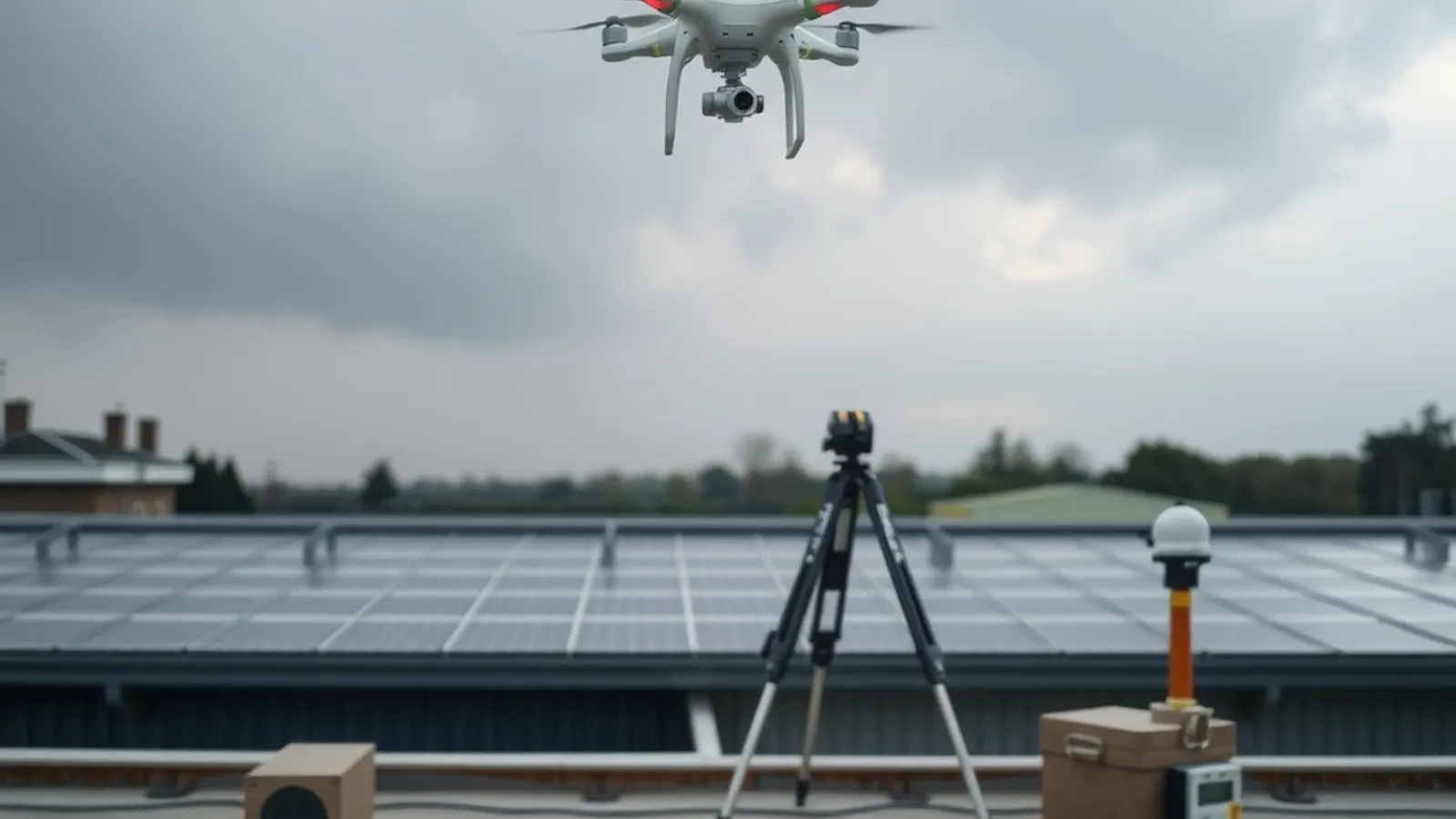
A commercial solar feasibility study answers one question: is this site worth developing, and on what terms? It looks at the data you hold, the roof or land, the shade, the grid connection and the likely cost and return. It ends with a written recommendation. Sometimes that recommendation is no. That is what separates it from an installer’s free survey, which exists to support a quote.
The steps, in order
The order matters. Each step is built to catch the problem that would make the next one a waste of money.
- Desktop review. Aerial images, any energy performance certificate, drawings of the building, and your half-hourly electricity data if you have it. This quickly rules out sites with an obvious flaw, such as heavy shade or too little space.
- Site survey. A physical look at the roof or land. For a roof, that means structure, covering, access and obstructions. This is where many promising sites are confirmed or dropped.
- Shading and orientation. Modelling of what the site would really generate, using its pitch, direction and nearby obstacles, not a general rule of thumb.
- Grid enquiry. An early question to the local network operator about spare capacity, likely cost and timing.
- Indicative cost and return. A range for the capital cost and payback, built on the facts from steps 1 to 4.
- Go or no-go report. The conclusion, the assumptions behind it and the risks that could change it.
What the roof survey looks at
A roof was designed for particular loads. Those include its own weight, fixed equipment, wind and snow. Solar adds permanent weight, and wind can lift an array as well as push it. LABC’s guide to retrofitting solar panels says an engineer should review any extra load, and refers readers to BRE Digest 489 on wind.
A good survey checks:
- the condition of the frame, including corrosion, movement and past repairs
- the age and remaining life of the roof covering
- whether the building has spare capacity for the extra load
- how panels would be fixed, since bolted and ballasted systems load the roof differently
- access routes, rooflights and plant that get in the way
If the covering may contain asbestos, the survey must flag it. The Health and Safety Executive explains how to deal with asbestos cement roofs. Our post on roof surveys before solar has a fuller checklist.
Where drawings exist, this step is quicker. However, where they do not, an engineer has to work out capacity from the building itself. Guessing is the shortcut a feasibility study exists to avoid.
The grid enquiry
Network operators use the Energy Networks Association’s G99 standard for anything beyond small generators. Each operator has its own version of the form. SSEN’s G99 application form is one example, and it shows the technical data you will have to supply.
At feasibility stage, you usually ask whether capacity looks available and what a connection might involve. A formal application can follow. A connection offer will state terms, any network work needed and a date. How long that takes depends on the operator and the local network, so start early. We explain the process in G99 for commercial solar, and where delays are building in grid capacity in 2026.
Regulation is still moving. In December 2025 Ofgem proposed reforms to speed connections, including stronger deadlines and penalties for network operators. The regime was to be developed during 2026. Do not plan around a faster process until you see it in an offer.
How long does a study take?
For one site, expect weeks, not days. The main variables are how fast you can get access, whether drawings exist, how tight the local grid looks, and how many sites are in scope. A portfolio of many buildings takes longer, and some work, such as a formal grid application, runs in parallel on its own timetable. Ask for a programme before you instruct.
What a real recommendation looks like
A report you can take to a board should include:
- A clear conclusion. Go, no-go, or go with a stated condition, such as “viable if roof strengthening is in scope”.
- The site facts behind it. Usable area, modelled annual generation, spare structural capacity and grid position.
- A cost and payback range. A range, with its assumptions, not one falsely exact figure.
- Risks that could change the answer. An unknown grid cost, a survey finding that needs specialist sign-off, or a planning constraint.
- What the specification must cover. So later bids can be compared like for like.
A report that always says yes is a sales document, because the value of paying for a study is that no is a real option, and that a yes is backed by numbers built for scrutiny.
Worked example (illustrative only)
Suppose a business owns a 5,000 square metre industrial roof. The desktop review shows little shade. The survey finds the covering is near the end of its life, and that the frame has limited spare capacity in one bay. The grid enquiry suggests the local network can take most of the output the roof could produce. The report might say: go, but replace the covering first, strengthen one bay, and size the system to the grid limit. Those findings are invented. They show how three small facts change a recommendation more than the roof area does.
Where a study fits
A study is the cheapest gate in a solar decision. It stops weak projects before design fees, tenders and installer visits begin. After it, you may want to compare ground-mount and rooftop options or look at how long installation takes. If you are weighing independent advice against a supplier’s survey, read independent advisor or installer survey.
Our feasibility study service covers the process described here, run independently of any installer.
Sources: LABC, guide to retrofitting solar panels; HSE, locations of asbestos and taking the right action; SSEN, G99 application form; Ofgem, connections reform package.
Our feasibility studies follow these steps and can end in a no. After a go, energy and ROI modelling builds the full case, while procurement and tender support turns the findings into a tender. If you would rather not pay upfront, PPA and financing advice compares the options.