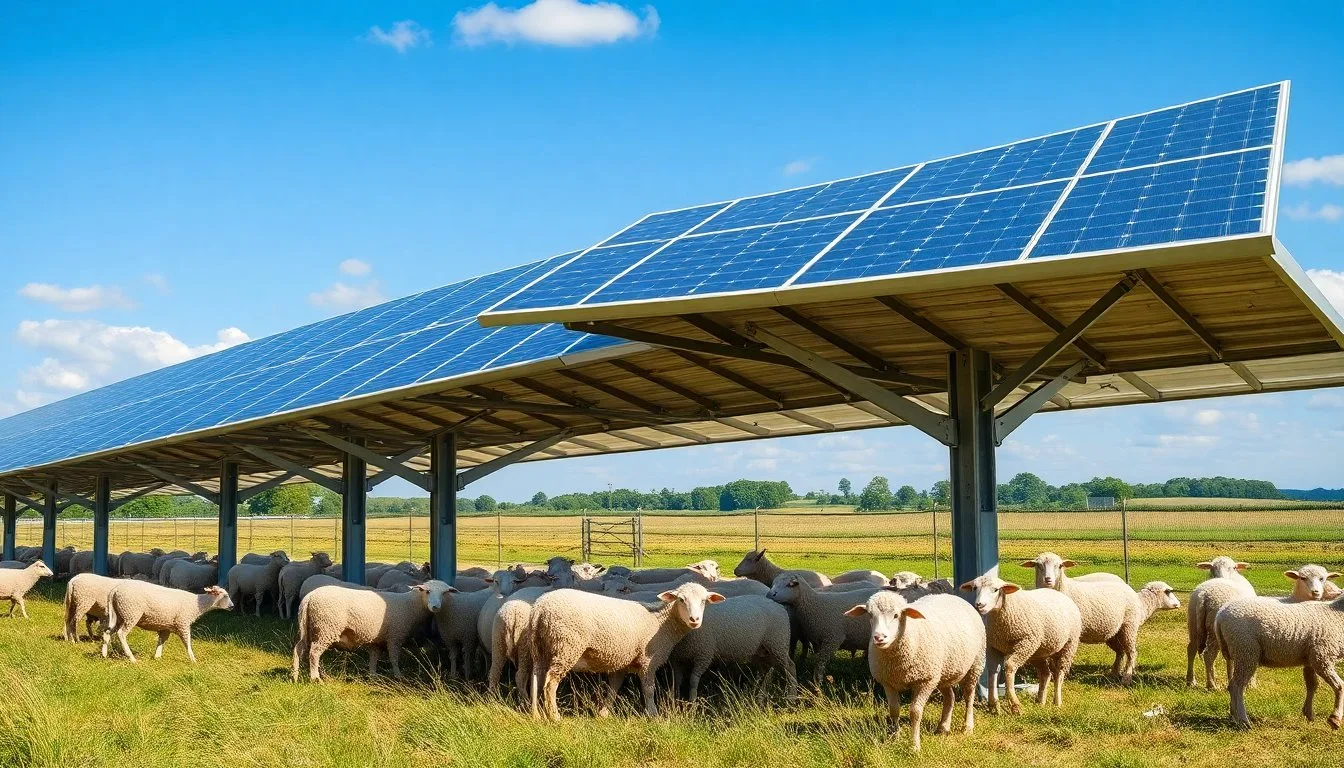
Agrivoltaics means farming and generating solar power on the same land. In the UK it mostly takes two forms. Sheep graze between and under ordinary panel rows, or arable crops grow between wider, higher rows. Grazing is common and cheap to arrange. Cropping is still emerging and needs a different design from the start.
For a landowner, the appeal is planning as much as income. A scheme that keeps land farmed is easier to defend than one that ends farming there. However, it does not guarantee consent.
What government says
The government’s UK Solar Roadmap, published in June 2025, sets an ambition of 45 to 47 GW of solar by 2030. It says many solar projects are designed to allow continued livestock grazing. It defines agrivoltaics as solar combined with arable farming. It calls this “a rapidly developing industry” that government is working to understand.
That wording matters. Grazing is described as already common, while arable agrivoltaics is described as new.
The Roadmap also keeps the planning protection for good land. A project that uses best and most versatile (BMV) land must justify it. It must also be designed to avoid, reduce or make up for the impact. Our guide to Agricultural Land Classification and solar leases explains how that test works.
Grazing under and between panels
Sheep are the usual choice. They keep the grass down in place of a mower, and the land stays in farm use. The Roadmap gives a small example. On one farm site, operating since 2014, 40 ewes and their lambs graze from April to October. The farm earns from lamb sales as well as land rent.
Grazing works with standard ground-mount frames, so the building cost is close to a solar-only scheme. Still, the detail changes:
- Cable protection. Cables must be routed and guarded so sheep cannot reach them.
- Fencing and water. Stock needs secure boundaries and a drinking supply.
- Vegetation. The grass mix and stocking rate need to match, or the sward either grows too tall or gets overgrazed.
- Who grazes. Local farmers are often given first refusal. At Bracks Solar Farm in Cambridgeshire, a 30 MWp site, BayWa r.e. says grazing is allowed once the grassland establishes and that local farmers have the first opportunity to take the licence.
Cropping between raised rows
Growing arable crops among panels asks far more of the design. For example, the frames may need to be higher so machinery can pass. Rows need spacing to suit your drill, sprayer and combine. Fewer panels fit on each hectare, so the site generates less than a solar-only layout.
Evidence for UK crops is thin. A University of Sheffield study published in February 2025 argues that agrivoltaics could meet UK solar targets. It points to East Anglia and the south east as promising regions. It also cites a separate project in Tanzania and Kenya, where maize, Swiss chard and beans did well in partial shade. That is not a UK field trial, so it is no proof for your own soil and weather.
If a developer says a crop will thrive under their panels, ask for the trial data. Also ask who carries the yield risk.
The planning angle
The government’s Land Use Framework for England says farming can continue alongside solar. It also commits to safeguarding the best farmland from permanent change of use. Together these point developers towards dual use on better land.
An agrivoltaic scheme gives an applicant a stronger argument, although it is only as strong as the evidence behind it. A real plan names the stock or crop, the numbers and the person responsible. A token line about sheep does not carry much weight.
Tenant farmers
If you farm the land as a tenant, read your tenancy and talk to your adviser before a landlord signs anything. The Roadmap notes that the Agricultural Holdings Act 1986 lets a tenant claim compensation for land lost after a change of use with planning permission. It also says government wants that compensation to be fair. Your position depends on the type of tenancy, so get specific advice.
What to check before you agree
- Who runs the grazing or cropping, and on what agreement? A licence to a local grazier, your own flock and a share-farming deal each carry different income and liability.
- Does the layout suit your stock and machinery? A design for someone else’s equipment is no use to you.
- How does the arrangement affect farm support payments? Scheme rules change. Check the current rules for your land. Our article on the Sustainable Farming Incentive and solar covers one common clash.
- What is the land grade, and when was it surveyed? An old survey or a soil-type guess is a weak basis.
- Who reinstates the land at the end? Put the standard and the date in the lease.
- Does the rent reflect the arrangement? See solar farm land lease payments for how rent is usually framed.
Part of a wider decision
Agrivoltaics answers a planning question. It does not settle the financial one. You still need to weigh grid connection, land grade and lease terms. You also need to compare the income with farming the land, or with generating power for your own use. Our land lease versus on-site solar guide sets out that choice. A feasibility study can test a proposal on your own land. For a related case, see how dairy farms weigh rooftop, ground-mount and grazing income. The agriculture and land sector page covers the farm side.
Because grazing changes the layout, test it early. A feasibility study checks panel height, fencing and the grid. Energy and ROI modelling puts lease rent beside farm income, and PPA and financing advice explains who owns the array. If the scheme supports a carbon goal, our net zero strategy work shows where it fits.