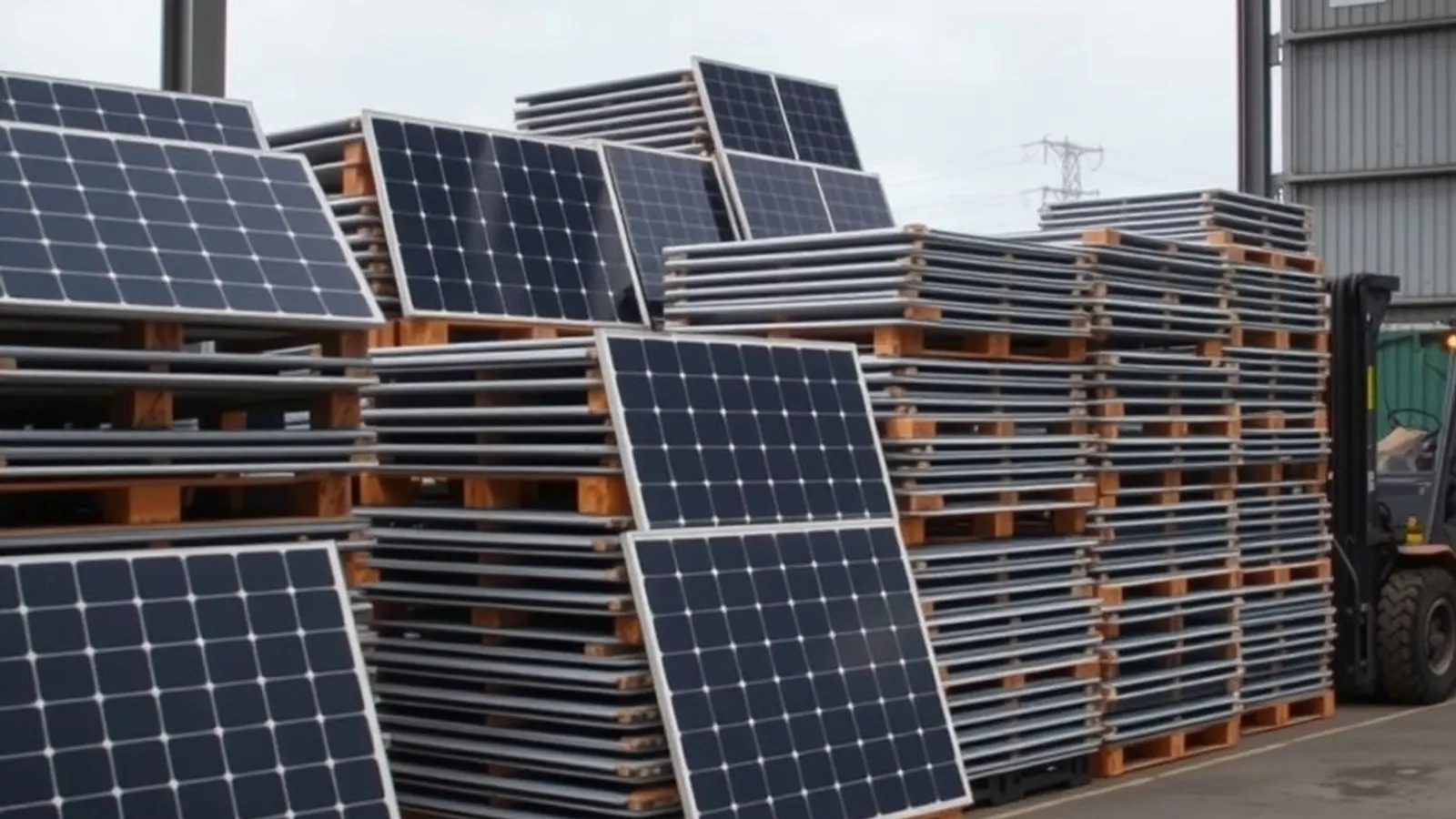
Solar panels are electrical waste, and in the UK they fall under the Waste Electrical and Electronic Equipment (WEEE) Regulations. For a business that owns an array, the practical rules are short. Panels must go to a proper treatment facility, not a skip. The maker or importer pays for recycling. And you, as the holder of the waste, must use a registered carrier and keep the paperwork.
Here is how that works, what it means for a roof or ground-mount array, and what to put in your contracts today so that the end of life is not a surprise in twenty-five years.
Are solar panels classed as WEEE?
Yes. The Environment Agency lists photovoltaic panels as category 14 of the WEEE categories. Its guidance says panels count as household equipment for reporting, wherever they are installed. That includes commercial roofs and solar farms. It also says the Agency does not treat solar farms as large-scale fixed installations, which would otherwise be outside the rules.
Inverters are a different case, because they sit in a separate category, so they follow their own route.
Who pays for recycling?
The producer does. Under regulation 12 of the WEEE Regulations 2013, each producer finances the collection, treatment, recovery and disposal of waste from users other than private households that comes from equipment it put on the UK market on or after 13 August 2005. A producer is usually the maker or the importer, not your installer.
Two things follow. First, you should not expect to pay a recycling fee on top of a compliant panel’s price, because that cost sits with the producer. Second, regulation 12 also lets a producer and a business user agree different arrangements. So the contract matters. If your supply agreement says you take on disposal, you may have done exactly that.
There is a catch for very old equipment. Under regulation 47, where waste comes from equipment placed on the market before 13 August 2005 and no replacement is bought, the final user pays. That is unlikely to affect modern arrays, but it explains why age matters.
What happens to the panels at a treatment plant?
They go to an approved facility. Government guidance sets recovery and recycling targets for photovoltaic panels of 80% recovery and 70% recycling at these plants. Those are targets for the plant, not a promise about every panel.
The Environment Agency also gives safety advice for sites that store panels. Disconnected panels can still generate electricity, so there is a shock and fire risk. Glass breakage is another hazard. Panels should be handled with care, stored glass side down and kept from breaking.
What are your duties as the owner?
You hold the waste, so the waste duty of care applies. Under the waste duty of care code of practice, you should:
- check that the carrier is registered, using the public register, and record that you checked
- agree a written description of the waste with the next holder, usually a waste transfer note
- keep the paperwork for two years for non-hazardous waste
Ask your contractor who the carrier and the treatment site are before the lorry arrives. A cheap quote that gives no names is a risk, because the legal duty stays with you.
What should the contract say?
Most arrays will last for decades, so the useful time to act is at purchase. Ask your installer or supplier for:
- the name of the producer and its compliance arrangements for the panels
- who is responsible for removal and disposal at end of life, in writing
- whether any end-of-life cost is included in the price or left to you
- what happens if the supplier no longer exists in 25 years
- for a lease or power purchase agreement, who removes the equipment and who pays, and by when
The last point matters most for leased roofs and power purchase agreements. Our guide to PPA red flags covers decommissioning clauses in more detail.
What about ground-mount arrays?
Ground-mounted arrays have more to remove. As well as panels, there are frames, cabling, inverters and sometimes fencing and foundations. Planning permission for a ground array may include a condition about removal at the end of its life. If yours does, put the cost in your lifetime budget and check what security the council wants.
Where the land is leased, the lease should say what must be removed and who pays. Our posts on solar farm lease payments and tenant farmers and solar leases cover the landowner’s side.
Do panels need to be replaced early?
Not usually. Panels slowly lose output rather than failing on a set date, and warranties vary. Our guide to degradation and warranties explains what the numbers mean. A drop in output does not make a panel waste. Many owners keep arrays going for as long as they pay their way.
Where we can help
We advise owners and landlords on contracts, not on panels, so we have no stake in what you buy. Our net zero strategy service covers lifetime planning, including what happens when an array comes to the end of its useful life.
Sources: GOV.UK, EEE covered by the WEEE Regulations; Waste Electrical and Electronic Equipment Regulations 2013; GOV.UK, WEEE evidence and national protocols guidance; GOV.UK, waste duty of care code of practice.
End-of-life terms belong in the contract, since nobody wants to argue about removal in twenty years. Our procurement and tender support writes them into the specification, while PPA and financing advice checks removal duties under a PPA or lease. Energy and ROI modelling includes decommissioning in the costs, and our net zero strategy work covers waste in your reporting.